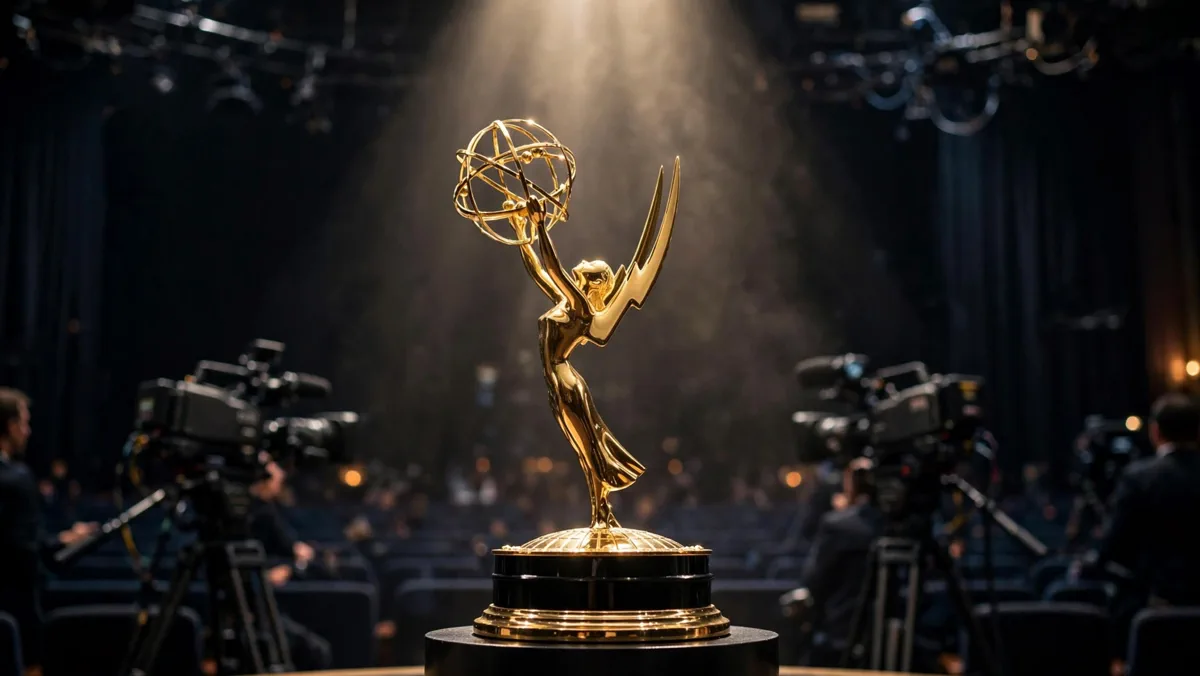
Television’s biggest night just dumped the networks. The Television Academy announced a six-year deal this week that hands the Primetime Emmy Awards to Amazon’s Prime Video, starting with the 2027 ceremony. After roughly 70 years on broadcast television, the Emmys will stream live, free, with no Prime subscription required, to viewers in more than 240 countries. And honestly? The cruelest part of this story is that nobody is even surprised. The shows that won this year’s Emmys were streaming shows. The audience that watched them was a streaming audience. The networks were just renting a ceremony that no longer belonged to them.
But this is still a historic moment, the biggest shift in how America watches its own television industry since the networks started airing the show in 1955. Here is what the deal does, why broadcast lost, and what it means for the next time you watch your favorite show win gold.
What the deal actually does
The Television Academy and Amazon announced the agreement on Tuesday. Prime Video becomes the exclusive global home of the Emmys for six years, running from the 2027 ceremony through 2032. Next September’s 79th Primetime Emmy Awards will be the first one to stream there.
Three details matter most. First, the show stays free. The Academy made free access a non-negotiable demand before talks even started, and Amazon agreed: no Prime subscription will be required to watch. Second, the reach is global. Amazon says the ceremony will stream live in more than 240 countries and territories, a scale broadcast networks never offered. Third, the deal goes beyond one night a year. Prime Video also gets other Academy programming, including the Hall of Fame and Honors ceremonies.
The deal officially kills the “Wheel Deal,” the rotation among ABC, CBS, Fox and NBC that had governed the broadcast for roughly three decades. The 2026 ceremony, hosted by Mariska Hargitay and aired September 14 on NBC and Peacock, was the last one under the old arrangement. NBC first aired the Emmys nationally in 1955, so this ends a run that lasted more than seven decades.
Why broadcast TV lost the Emmys
The networks did not lose this in a bidding war last week. They lost it over twenty years, one remote control at a time.
Start with the ratings. This year’s Emmys drew about 6.7 million viewers, down nearly 10 percent from the previous year. That is well above the record low of 4.3 million viewers in January 2024, but it is a ghost of the nearly 22 million people who watched the show in 2000. The audience did not vanish. It moved.
Nielsen reported that streaming accounted for 49 percent of all television viewing in July, compared with 19.5 percent for broadcast and 18.7 percent for cable. Streaming is not the future of TV watching. It is the present, and broadcast is the smaller room.
Then look at the winners. This year’s top prizes went to Apple’s “Widow’s Bay” for comedy and HBO Max’s “The Pitt” for drama. Both are streaming originals. The streamers have, as Page Six put it, come to utterly dominate the prestige categories at the Emmys. Imagine winning television’s biggest honor on NBC while the shows being honored were built, funded and streamed by someone else. That tension could not hold forever.
Academy chairman Cris Abrego framed it as inevitability. “Television has never been more global, and the Emmys should be a celebration that the world can share,” he said in the announcement. He told the Associated Press that a single long-term partner changes everything about planning: “With one partner over six years, we can really learn together and build from year to year together” (via Page Six). After thirty years of starting over with a different network every September, you can see the appeal. The pull of prestige streaming keeps growing too: HBO’s The Gilded Age is heading into its fourth season on HBO Max, another heavyweight that lives entirely outside broadcast.
The money nobody will talk about
Neither side disclosed the financial terms, which in television-speak means someone got a very good deal and someone got a slightly less good one. Early estimates do not agree: Deadline reported the deal is worth $20 million to $25 million a year, which would total more than $120 million over its life, while Variety, citing its own sources, put the annual fee closer to $15 million (via Gazettely).
That gap is worth noting because it tells you what the industry itself is unsure about: what is the Emmy telecast actually worth anymore? At 22 million viewers it was priceless. At 6.7 million and falling, it is a prestige property whose value depends entirely on whether someone can make it matter again. Amazon is betting it can. The broadcast networks, who let it walk, appear to be betting it cannot.
What this means the next time you watch
If you just want to watch the show, this is mostly good news. You do not need a Prime membership, you do not need a cable package, and you do not need to live in the United States. Open the stream in September and it plays, wherever you are in those 240-plus countries.
The Academy is also promising the show itself will feel different. Officials say they do not plan to simply repeat the old format on a new platform, and Amazon and the Academy say the partnership will include new ways for fans to engage with the show throughout the year, though they have not detailed those plans yet. And there is more change coming behind the scenes: Abrego says a planned merger with the National Academy of Television Arts and Sciences remains on track for as early as mid-2027, before the first Prime Video telecast.
Here is what to watch for when the 2027 show arrives:
- The global number. A free worldwide stream should massively outdraw 6.7 million US viewers. If it does not, that tells its own story.
- The format. A six-year runway with one partner means the Academy can experiment. If year one is just a network telecast with an Amazon logo on it, they will have wasted the whole point.
- The advertiser question. Free streaming does not mean cost-free production. Somewhere, somehow, someone is paying for that global production. Watch for how it shows up.
The dominoes are falling
The Emmys are hardly the first major awards show to abandon broadcast. The Academy of Motion Picture Arts and Sciences announced in December 2025 that the Oscars will leave longtime home ABC for YouTube starting in 2029, in a deal running through at least 2033, citing the same desire for global, free access. And the Grammys move to Disney next year, spreading across ABC, Hulu and Disney+.
See the pattern? The Oscars went to a video platform. The Grammys went to a streamer bundle. The Emmys went to a streamer. Within three years, all three of American entertainment’s biggest award nights will live on the internet rather than on the airwaves that made them famous. Hollywood’s power map is being redrawn everywhere at once: this very week the Skydance Corporation debuted on the NYSE after closing its merger with Warner Bros Discovery.
That is not a coincidence. It is the audience, voting with its viewing hours. When half of all TV time goes to streaming and the most celebrated shows are made by streamers, the ceremony celebrating those shows following them onto streaming is less a surprise than a formality.
The one real risk
Mike Hopkins, head of Prime Video and Amazon MGM Studios, knows the clock is ticking. “We’re on the clock, we gotta get rolling,” he told the AP, noting that unlike the Oscars’ deal, which kicks in three years from now, this one is effective immediately.
The risk is not technical. Amazon can stream anything to anywhere. The risk is emotional. For seventy years, the Emmys were a broadcast event: families and friends gathered, the show played live on a channel everyone had, and it felt like television celebrating itself on its own turf. A stream that anyone can watch is also a stream that anyone can skip, pause, or half-watch while scrolling. Amazon and the Academy have to make the 2027 show feel like an event worth showing up for, not just content that happens to be live.
Still, if anyone has the global reach to pull that off, it is the platform that already sells you everything else in your house. The bet is that the Emmys can be bigger as a worldwide celebration than they were as a broadcast telecast. Given that broadcast was down to 6.7 million viewers and shrinking, it is not a hard bet to make.
Broadcast television did not lose the Emmys in a meeting this week. It lost them years ago, one streaming subscriber at a time. Amazon just signed the paperwork.