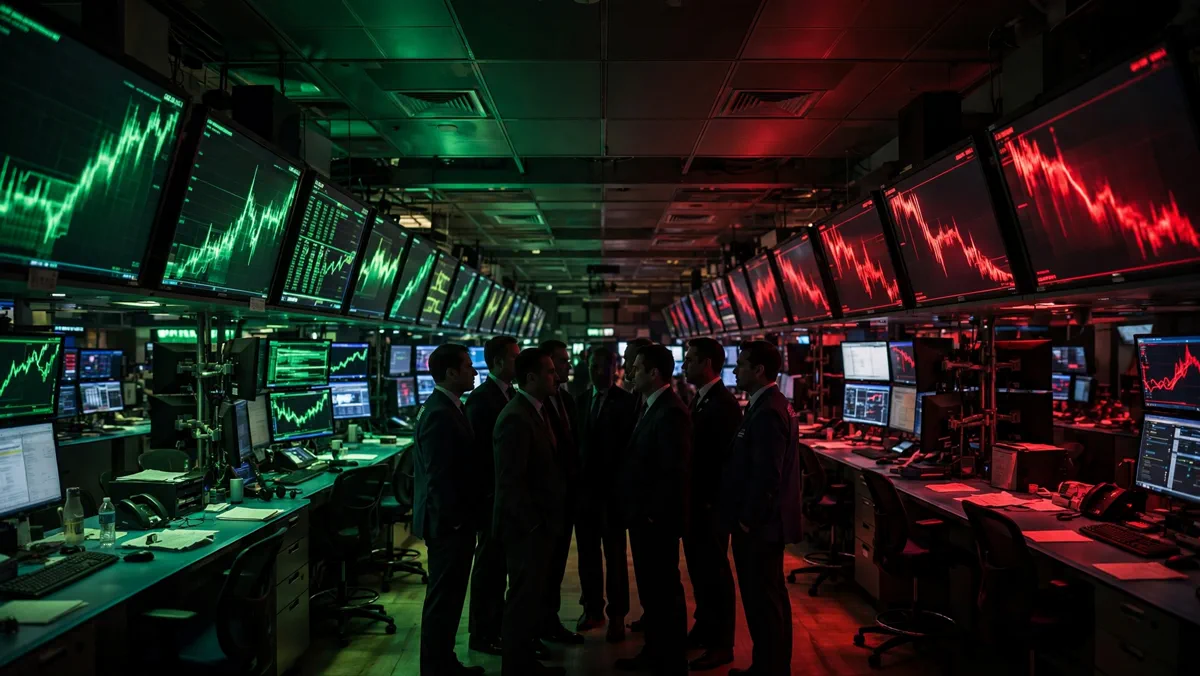
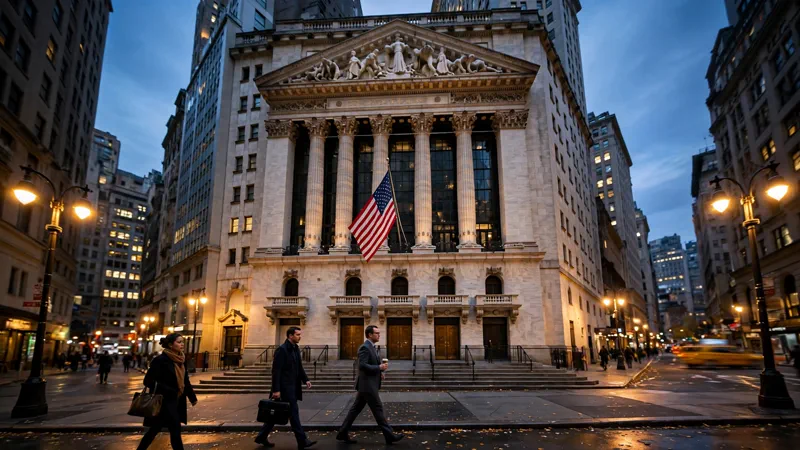
Thursday morning on Wall Street felt like two different markets trading on two different planets. The Dow Jones jumped more than 270 points by mid-morning, with old-economy stocks like cereal makers and insurance companies leading the charge. At the exact same time, the Nasdaq was sinking for the second straight day, tech stocks were getting shredded, and chip stocks were headed for what would be their eighth straight losing session.
How do you get a market that climbs and crashes at the same time? Two red-hot inflation reports in two days, a record profit that nobody wanted to hear about, and a growing panic over how much debt the AI boom is running on.
A market that cannot make up its mind
The early numbers told the whole story. Just after Thursday’s open, the Dow climbed 0.6% while the S&P 500 lost 0.3% and the Nasdaq dropped 0.9%. By midday the gap was even wider: the Dow up 273 points (0.5%), the Nasdaq down 1.3%.
This came one day after the worst session since July. On Wednesday, the S&P 500 fell 1.11% to 7,718.94 and the Nasdaq sank 1.88% to 26,692.87 after September inflation came in hotter than expected. The Dow barely budged that day, down just 0.09% to 51,621.48.
So in two days, the story is the same: everything tied to AI and chips gets sold, and everything boring gets bought. On Thursday, General Mills bounced 5%, and insurers Marsh & McLennan, Arthur J. Gallagher, and Erie Indemnity all posted similar gains. Nobody is buying cereal stocks because they think the future is bright. They are buying them because they want somewhere to hide.
Inflation, twice in two days
The trigger for all of this was wholesale inflation, and it was ugly. The September Producer Price Index jumped 1.3% month over month, more than double the 0.6% economists expected. On an annual basis, wholesale prices climbed 6.3%, well above the 5.5% forecast and the largest 12-month increase since December 2022, according to the Bureau of Labor Statistics.
That came exactly one day after the consumer version of the same story. September CPI rose 0.6% for the month and 3.7% year over year (economists expected 3.6%), with core inflation at 2.6%. Gasoline alone jumped 9.1% in a single month and supplied more than half of the monthly increase.
Two hot inflation prints, back to back, have rewritten the Fed’s script. Before the CPI data, traders saw about a 22% chance of a rate hike at the October meeting. After Thursday’s PPI, those odds had climbed to roughly 37%. The next FOMC decision lands on October 28, and Fed Chair Warsh speaks publicly on Friday, which means the market gets to stew for one more day before it hears anything close to an answer.
Here is the twist, though. The data was not all bad. September retail sales rose 0.8%, double what economists expected, which means American shoppers are still spending freely. And weekly jobless claims came in at 199,000, a tick below the 200,000 consensus. A strong consumer and a calm labor market would normally be good news. But when inflation is running hot, every strong number just adds to the case for higher rates. That is why the market treated good data like bad data all morning.
TSMC made $23.4 billion and nobody cared
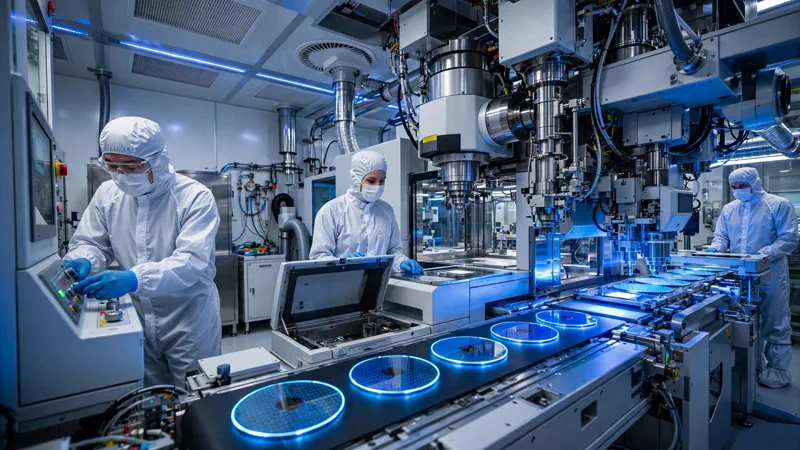
On paper, Thursday was a triumph for the most important company in the AI supply chain. TSMC reported a record third-quarter net profit of NT$763.06 billion (about $23.4 billion), up 68.7% from a year ago and ahead of the NT$746.3 billion analysts expected. Revenue hit NT$1.49 trillion ($46.72 billion), also a record.
The details were almost comically strong. Gross margin of 66.4% means the company keeps roughly half of every dollar of revenue as profit. High-performance computing, the segment that holds AI chips, made up 68% of revenue, up from 57% a year ago. The new 2-nanometer process ramped from 3% of wafer revenue in the second quarter to 8%. CEO C.C. Wei said he now expects 2026 revenue to grow around 44% in dollar terms, and guided fourth-quarter revenue to $52.3 to $54.3 billion, about 14% above the third quarter.
This was TSMC’s sixth consecutive record quarter. And the stock fell 2%.
It was not alone. Overnight in Asia, Samsung plunged 9.9% and SK Hynix cratered 11.6%. Japan’s Nikkei dropped 4.8%. The Philadelphia Semiconductor Index fell 4.3% on Wednesday for its sixth straight down day, and it was dropping again on Thursday. When a company prints the best quarter in its history, raises its guidance, and the shares fall anyway, the market is telling you something: nobody is worried about AI demand anymore. They are worried about AI debt.
The AI trade’s debt problem
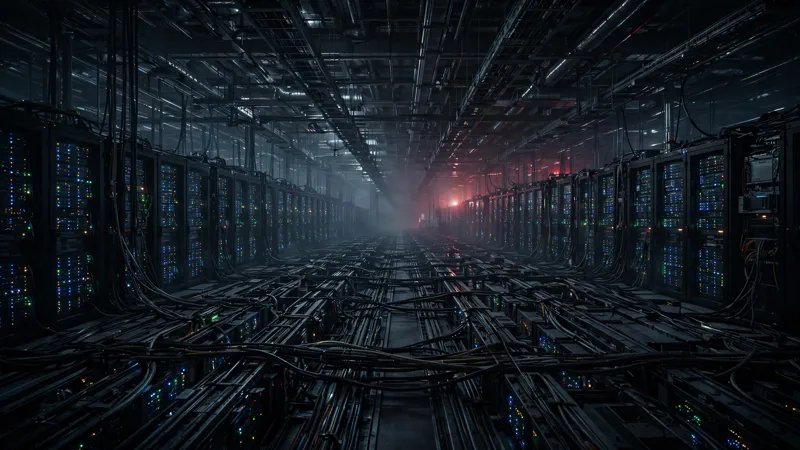
This is the fear that has been building all week, and it finally has a face: CoreWeave. The Nvidia-backed data center company crashed 15.5% on Wednesday and was down another 8% on Thursday morning, making it the biggest loser in the Nasdaq 100 two days running. The concern is straightforward: companies are borrowing enormous amounts of money to build AI data centers, and investors are starting to ask what happens if the AI revenues do not arrive on schedule.
Nebius, another data center operator, fell 10% in sympathy. The whole AI infrastructure complex is getting repriced at once. Even the margin story at TSMC itself had a wrinkle: gross margin dipped to 66.4% from 67.7% in the second quarter, with management blaming dilution from the early 2-nanometer ramp and overseas fabs.
A few numbers that capture the mood right now:
- September PPI: +6.3% year over year, the hottest wholesale inflation since December 2022
- Chip stocks: down 6 straight sessions through Wednesday, falling again Thursday
- CoreWeave: down roughly 23% in two days on debt fears
- 10-year Treasury yield: spiked to 5.33% after CPI, then plunged to 5.06% as investors fled tech for bonds
- Gold: near $4,143 an ounce, as the safe-haven bid came roaring back
- Bitcoin: sliding to around $81,100, because crypto is not anyone’s idea of safety right now
Rocket Lab added its own drama, plunging 12% after delaying the first launch of its Neutron rocket to 2027. It was supposed to fly by the end of this year.
What actually matters next
Strip out the noise and Thursday’s message is simple. The AI boom’s financial engine is fine: TSMC just proved the demand is real, with customers already discussing equipment orders years into the future. But the trade’s funding model is now under interrogation, and inflation has taken away the market’s favorite drug, which is the promise of rate cuts.
Brent crude is hovering near $104 a barrel, with reports of Strait of Hormuz shipping attacks keeping oil traders on edge. WTI sits near $96.50. Every dollar of oil is another dollar of inflation the Fed will have to talk about.
What to watch in the next two weeks:
- Friday: Fed Chair Warsh speaks, the first chance for the Fed to respond to two hot inflation prints
- October 28: the FOMC decision, where a 37% hike probability is now priced in
- October 29: September PCE inflation, the Fed’s preferred measure, which will either calm the market or pour gasoline on it
Until then, expect more of the same: the old economy climbing a wall of worry, and tech trying to figure out whether the AI boom is a revolution or a very expensive IOU. Thursday’s split screen is not confusion. It is a market repricing the cost of everything, one stock at a time.
For more on this week’s inflation drama, read our breakdown of Wednesday’s hot CPI print and our preview of the ASML and TSMC earnings week. You can browse all of our market coverage in the Markets section.