Wall Street’s Wildest Week in Months Ended With One Big Question: Is the AI Party Over?
This week on Wall Street felt like two different markets living in the same building. On Thursday, the Dow Jones jumped 556 points while the Nasdaq spent most of the day deep in the red before clawing its way back. On Friday morning, the split showed up again: the Dow ticked higher while tech sagged. If you watched only one index this week, you missed the real story. The real story is the money moving, and where it is going next is the most interesting part.
For two years, the trade was simple: buy anything with “AI” in the pitch deck and worry about the details later. This week, investors started worrying about the details. And the details are uncomfortable: debt-fueled AI spending, two hot inflation reports, and a brand-new Fed chair who just gave his first big speech without saying what anyone wanted to hear.
The week by the numbers
Let us start with the scoreboard, because it tells the story in five lines:
- Dow Jones: up about 1% for the week, closing Thursday at 52,177.69 after a 556-point pop
- S&P 500: down roughly 0.9% for the week, closing Thursday at 7,744.06
- Nasdaq: down about 2.4% for the week, on pace to snap its four-week winning streak
- 10-year Treasury yield: fell to around 5.09% after spiking to 5.33% on Wednesday’s hot CPI report
- Gold: surged 2.06% to $4,192.50 an ounce, while Bitcoin dipped below $80,000 midweek before bouncing back above $82,000
That gap between the Dow and the Nasdaq is the whole story. It is one of the widest divergences in months, and it means investors are not just selling. They are rotating.
The great rotation: out of AI, into health care and soap
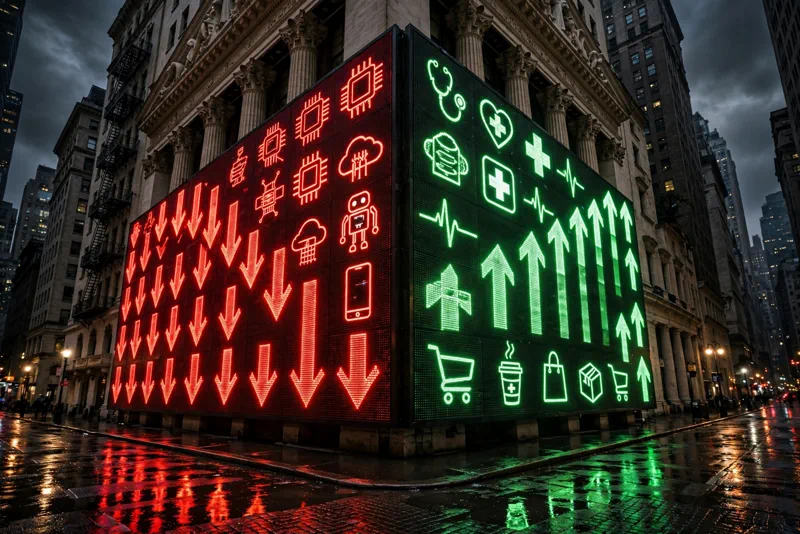
Rotation is Wall Street’s polite word for a stampede with better marketing. This week, money poured out of technology and into the most boring corners of the market. Health care stocks climbed to record highs. An equal-weighted version of the S&P 500, which treats every company the same instead of letting Apple and Nvidia call the shots, rose 1.4% on Thursday. More than half of all S&P 500 stocks now trade above their 200-day moving average, up from about 40% at the end of September. The market is broadening, and that usually happens when the old leaders are in trouble.
The earnings reports told the same story. Kimberly-Clark, the company that makes your paper towels, jumped 4.7% after beating expectations. Marsh, an insurance broker, climbed 4.6%. BNY, a 240-year-old bank, rose 3.2%. These are not exciting companies. That is exactly the point. When investors start paying up for paper towels and insurance brokers, they are telling you they are scared of something else.
What they are scared of is the AI trade. The Philadelphia Semiconductor Index fell for seven straight sessions. Server stocks got crushed: Dell dropped roughly 6.9% and HPE fell about 7.1% on Thursday. Nvidia, the poster child of the entire AI boom, trimmed an early 3.8% loss to close down 1.8% on Thursday. Tesla, oddly enough, popped 3% in premarket trading Friday after unveiling a jaw-dropping Roadster redesign, but even that was the exception that proved the rule.
Why investors are suddenly scared of AI debt
The fear has a name: debt. Wall Street spent the week asking an uncomfortable question about the AI buildout. Who is actually paying for all of this, and what happens if the returns take longer than the loan payments?
CoreWeave, the cloud provider backed by Nvidia, sat at the center of the storm. Its debt-heavy balance sheet has investors spooked, and the stock got hammered for two straight days before rebounding Thursday after Nvidia CEO Jensen Huang voiced optimism about the company. Nebius, another AI infrastructure name, slid about 10% on Thursday. Rocket Lab fell 6.6% after delaying its Neutron rocket’s first launch to 2027 over a manufacturing issue, which is a different kind of story but fed the same mood.
This is not a small-cap sideshow. The AI trade has been the engine of the entire market for two years. If the engine is now running on borrowed money and investors are starting to do the math on that debt, the whole market has to reprice. That is what this week’s rotation really is: a rehearsal for a market where AI stocks are not the automatic answer.
Keep in mind, the inflation data did not help. Wednesday’s consumer price report came in hot at 3.7% year over year, and Thursday’s producer price report was even worse: up 1.3% for the month, the biggest jump since March 2022, with annual PPI at 6.3%, the highest since December 2022. Diesel prices are up 115% from a year ago. That is not a typo.
Kevin Warsh’s first real test
If there was one person this week who could have calmed the market down, it was the new Fed chair, Kevin Warsh. He chose not to. Speaking overnight at an International Monetary Fund meeting in Bangkok, Warsh refused to signal whether the central bank will hold rates steady or hike at its October 27-28 meeting or in December. “It’s a new chapter at the Fed, and we’re not in that business anymore,” he said, making clear he does not prejudge meetings.
Traders got the message. The odds of a rate hike at the late-October meeting dropped to about 15% from 28% the day before, while the odds of a hike by December sit near 87%. The 10-year Treasury yield, which spiked to 5.33% after the CPI report, slid back toward 5.09% as the tech selloff sent investors hunting for safer assets. Bonds, briefly, became the calm corner of a stormy week.
Here is the tension: inflation is running hot, but the market is starting to fear the AI debt bubble more than it fears the Fed. That is a strange sentence to write, and it tells you how weird this moment is.

Gold and Bitcoin staged their own comebacks
While stocks split in two, the alternative assets put on their own show. Gold surged to $4,192.50 an ounce on Thursday, up 2.06%, as investors reached for the oldest safe haven in the book. When the stock market cannot decide whether it is scared of inflation or scared of AI debt, gold just shrugs and collects the fear premium from both sides.
Bitcoin had the wilder ride. After the hot inflation data hit on Wednesday, Bitcoin plunged below $80,000, and forced liquidations of leveraged bets neared $1 billion as the $79,800 support level gave way. By Friday morning, it had bounced back above $82,000, with Ethereum recovering to around $2,444. Eight of the top ten cryptocurrencies finished the day in the upper part of their daily ranges.
But do not mistake a bounce for a vote of confidence. Bitcoin and Ether funds lost a combined $390.9 million in the US session on October 14, which means institutional money was heading for the exits even as prices stabilized. The crypto market is healing, but the scar tissue is real.
What to watch next week
The respite this weekend will not last long. Next week brings the first of the Magnificent Seven earnings reports, with Tesla on deck alongside Netflix and Meta. After a week like this one, those reports are not just earnings. They are a referendum on whether the AI story still justifies its price tags.
Traders will also be watching industrial production data due Friday, oil prices that refuse to calm down (Brent near $106, WTI near $98), and the Fed’s late-October meeting creeping closer. The Dow is holding up, health care is at record highs, and gold is glowing. The question for next week is whether tech can join the party again, or whether this week’s rotation was the start of something bigger.
Two years of one-way AI euphoria trained investors to buy every dip in tech without thinking. This week, thinking made a comeback. Sometimes the most important thing a market does is remind you that trees do not grow to the sky, even the ones made of silicon.
Read our earlier coverage: Wall Street Split in Two: the Dow Climbed as the Nasdaq Crashed and ASML Just Doubled Its Profits. Wall Street Sold Off Anyway. Blame the CPI Report. More in the Markets archive.
Sources: Investopedia, Barron’s, Crypto Times