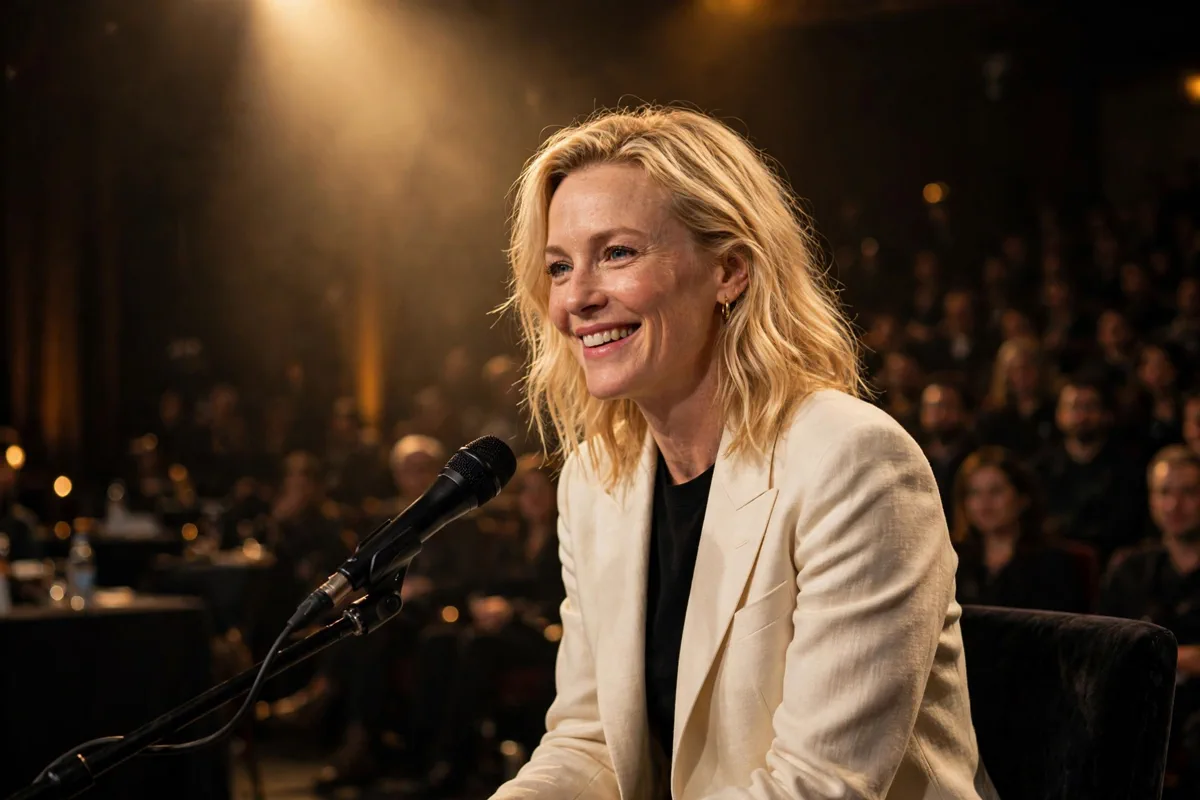
There is a particular kind of Hollywood honesty that arrives when an actor stops caring about what the room wants to hear. Amanda Seyfried found hers on a stage in East Hampton, in front of Alec Baldwin, in front of an audience that came to celebrate her work and left talking about the job she walked away from. “I passed on a show where I would have to have sex all the time because of the sex,” she said. Then she kept going, because she was not finished: it did not matter who the co-star would be, she was not into it right now, and she was done apologizing for feeling uncomfortable about it.
It was not a scandal. It was not a complaint. It was a 40-year-old mother of two saying the thing most actors of her stature only whisper to their agents: her kids are old enough now to know what she does for a living, and she is done being a pushover. That phrase was hers, and it is worth sitting with.
The panel where she said it
The setting matters. This was not a talk-show couch or a red-carpet ambush. Seyfried was at the Hamptons festival for her film The Life and Deaths of Wilson Shedd, directed by Tim Blake Nelson, in which she plays a teacher trapped in an abusive relationship who takes a job inside a maximum-security prison and falls for an inmate played by Scoot McNairy. The film premiered at the Toronto International Film Festival and made its stateside stop in East Hampton, where Baldwin moderated a career conversation that went somewhere no publicist pre-approved.
What she described was not a bad experience. It was a boundary. She told Baldwin that acting has become stranger to her with age, that the job requires performers to be romantic with people they feel nothing for, and that the experience ranges from genuinely great to genuinely uncomfortable. What made the room lean in was the contrast with who she used to be.
It used to be fun
The Seyfried of twenty years ago had a completely different relationship with on-screen intimacy. She admitted as much herself, laughing a little at the memory of a younger woman who treated a make-out scene like a perk of the job. Back then, she told Baldwin, it was no big deal. The idea of getting paid to kiss an attractive co-star sounded like a bonus day at work. The room laughed because every working actor recognizes the specific innocence of that era, before the industry, and life, grew up around them.
But she is 40 now, and the arithmetic of the job has changed. She has two children, daughter Nina, 9, and son Thomas, 6, with her estranged husband Thomas Sadoski, and she said plainly that her kids are now paying attention to what she does. That attention changed the calculus of every script that lands on her desk. A role that requires being naked with a stranger for a season is no longer a fun day at the office. It is a decision her children will eventually watch, and she has decided she does not want that version of herself on the record right now.
She left the door open without apologizing for the boundary. If the project came back around at a later point, she said, maybe she would feel differently. But for now, she does not want to deal with being naked with a stranger. There is a world of difference between never and not right now, and Seyfried refused to collapse them.
The kid who taught her to say no
The most telling moment of the panel may not have been about sex scenes at all. Seyfried described being out in Manhattan with Nina when a stranger asked for a photo. She said no. Her daughter, she said, was proud of her for it. Later she did the same thing with a coffee shop barista who asked for a picture. Small moments, but they reveal the real engine of the shift: she is raising two children who watch how she handles pressure, and she has decided that modeling “no” matters more than modeling compliance.
The line about being less of a pushover lands because of how rare it is for a successful actor to claim it. Pushover is the language of green rooms and early auditions, of the 19-year-old she once was who, as she has said in past interviews, went along with uncomfortable situations on set because she feared upsetting people and losing the job. The distance between that teenager and the woman on the Hamptons stage is the whole story: two decades of learning that the career survives the refusal, and that the refusal sometimes is the career.

Hollywood’s new line in the sand
Seyfried is not the first actor to draw this line, but she might be the frankest about the mechanics of it. Since the #MeToo movement, intimacy coordinators have become standard on film and television sets, turning what used to be improvised and awkward into choreographed, consent-driven work. The industry, in other words, has already admitted that sex scenes were a problem. What Seyfried did was admit the problem from the other side of the camera: even with every safeguard in place, she does not want to do it, and the reason is not trauma or fear. It is that she is a grown woman with two kids and she is allowed to be uncomfortable.
That framing is quietly radical. It treats boundary-setting as ordinary professionalism rather than a scandal. Notice what she did not do: she did not name the show, did not badmouth the producers, did not frame herself as a victim. She named a feeling, set a term, and moved on. It is the same energy as telling the stranger in Manhattan no while her daughter watches.
The industry is still adjusting to this version of power. For decades, saying no to a sex scene read as difficult or career-limiting, especially for women. A generation of actresses has spent the last decade rewriting that script, and Seyfried just gave them their cleanest soundbite yet: she is not into it right now, and right now is enough.

What we know about the mystery show
Almost nothing, and that is probably deliberate. Seyfried did not name the series, the network, the character, or the creative team. All she said is that it would have required her to be intimate on camera constantly, and that the quantity was the dealbreaker. Here is the context that makes the refusal interesting:
- She is not short on work. In the last year alone she has appeared in two films, The Testament of Ann Lee and The Housemaid, plus Peacock’s Long Bright River. Passing on a show was not desperation management. It was a choice made from strength.
- Her TV resume is stacked. Long Bright River, The Dropout, The Crowded Room, Twin Peaks, Big Love. She knows exactly what a prestige series asks of its leads, which makes her read of the material credible, not naive.
- The film she was actually promoting, The Life and Deaths of Wilson Shedd, is built around an abusive relationship. She is not avoiding difficult material. She is avoiding material that asks her to be naked with strangers for no reason she believes in.
- She is an Oscar nominee (for Mank) with a Golden Globe to her name. Actors at that level can afford the no. Her point, implicitly, is that actors at every level should be able to.
Why this one is going to stick around
Stories like this usually flare and fade in a news cycle. This one has legs. The first reason is the quote itself: it is the kind of sentence that gets repeated in green rooms for years, because it is funny, honest, and a little bit brave. The second is timing. Seyfried and Sadoski announced their separation in September after nine years together, which means the boundary she is describing was drawn during one of the most scrutinized chapters of her adult life. She chose, in the middle of it, to talk about saying no to things that do not serve her.
The Life and Deaths of Wilson Shedd does not yet have a theatrical release date, but Seyfried will be back on the awards-season circuit soon enough, and this story will follow her. Good. A working mother of two looked at a blank check with a sex-scene clause and said she was not into it right now. The kids, as she said, are paying attention. So is everyone else.
For more on Hollywood’s shifting boundaries, see our entertainment coverage at vidx.online/entertainment, including our look at Tom Cruise’s very different kind of career gamble this month (Tom Cruise’s $135 Million Movie Just Opened to $8 Million). Seyfried’s remarks were first detailed by EW, with Page Six and Parade carrying the full panel account.