
Here is a number that should make every American sit up a little straighter: 46.3. That is where consumer sentiment landed this week, according to the University of Michigan’s closely watched survey, and if the preliminary reading holds, it would be the second-lowest score in the survey’s 74-year history. Lower than the Vietnam War. Lower than the oil crisis of the 1970s. Lower than 9/11, the Great Recession, Covid, and the inflation surge that came after. The only month worse was this past May.
Five of the ten lowest readings on record have now happened this year. This is not a blip. It is a mood, and it is getting darker by the month.
The question worth asking is not why people feel this way. Anyone who filled a grocery cart this week knows the answer: prices. The more interesting question is what this bleak mood tells us about where our money is headed next. Sentiment this dark has a way of fulfilling itself.
The number that stopped the presses
The headline figure, released Friday, October 9, showed the sentiment index dropping to 46.3 from a final reading of 48.1 in September. Economists polled by Reuters had expected 47.8, so this was not just bad, it was worse than bad. And the details underneath are uglier still.
The index’s measure of current economic conditions tumbled 12.2 percent in a single month to hit an all-time low of 44.7. Not a low for the year. An all-time low. Ever.
People’s expectations for inflation are climbing right along with their gloom. The Michigan survey showed year-ahead inflation expectations ticking up to 4.7 percent from 4.6 percent. In February, before the US-Israeli war with Iran sent energy prices climbing, that figure was 3.4 percent. Longer-run expectations rose to 3.5 percent from 3.4 percent, and those matter a lot to the Federal Reserve, because when people expect prices to keep rising, they spend faster and demand bigger raises, which pushes prices up further.
A separate survey from the Federal Reserve Bank of New York, released Wednesday, tells the same story from a different angle (details here). Its one-year inflation expectation hit 3.9 percent, the highest since May 2023. Households expect gasoline to rise 4.8 percent, food 5.5 percent, rent 6.8 percent, medical care 9.2 percent, and college tuition 7.5 percent. Every single category the New York Fed tracks moved up. Not one got cheaper.
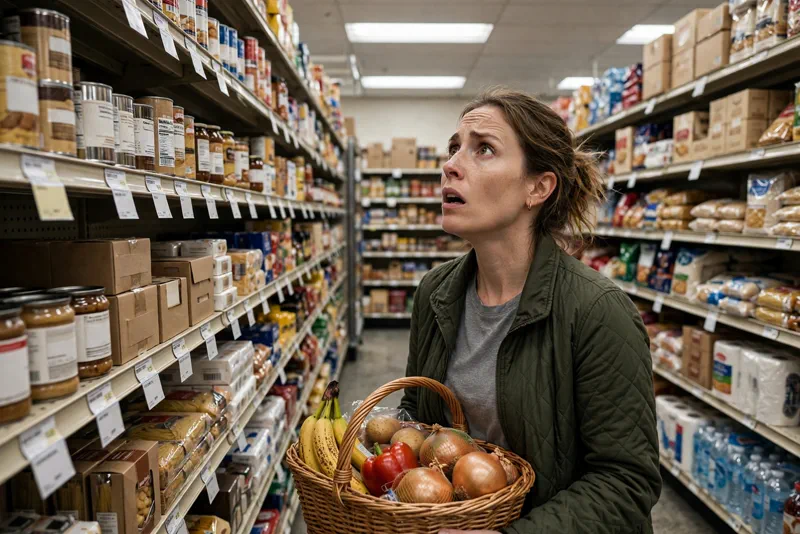
87 percent say it is a bad time to buy a home. The car numbers are almost as grim.
Here is the stat that economists are quietly panicking about. Buried in the surveys is a set of questions that ask whether now is a good time to buy things. James Knightley, chief international economist at ING, summed up the answers: 73 percent of Americans think it is a bad time to buy a household appliance. 78 percent say it is a bad time to buy a vehicle. And 87 percent say it is a bad time to buy a home.
“These are all key drivers of economic activity,” Knightley said (via CNN), which is economist-speak for: this is how recessions start. Big purchases are the engine of the American economy. When nearly nine in ten people look at the housing market and say “nope,” that engine is sputtering.
The 30-year fixed mortgage rate is sitting at 7.54 percent, near its highest since late 2023 after the biggest weekly jump in four years. The monthly payment on a $500,000 mortgage at 7.28 percent is $3,421, versus $2,991 back in February. That is more than $400 extra every single month for the same house. Meanwhile sellers are cutting prices at the fastest rate in four years, which tells you the standoff between frozen buyers and stubborn sellers is finally cracking.
The cruel math behind the mood
Now for the part that should really get your attention, because it explains why this is not just vibes. The New York Fed survey found that Americans expect their household spending to grow 5.5 percent over the next year, the highest reading since May 2023. But they expect their income to grow only 3.1 percent.
Spending is expected to grow almost twice as fast as income. That gap does not close by magic. It closes in exactly two ways: households drain their savings, or they take on more debt. The survey confirms it. More than half of consumers say their savings would last three months or less if their income stopped tomorrow. It is the same squeeze that has even six-figure earners living paycheck to paycheck.
This is the trap of 2026 in one sentence. Prices rise faster than paychecks, the surveys prove it, and the Federal Reserve is making it more expensive to bridge the gap with credit. The Fed raised its benchmark rate last month for the first time in three years, with at least one more hike likely this year. Every hike is a pay cut for anyone carrying a variable-rate balance.
Joanne Hsu, the director of the Michigan surveys, put it plainly: “Frustration over cost-of-living continues to mount, as consumers across the political spectrum believe that the trajectory of the economy has weakened since the beginning of the year.” The steepest drops in sentiment this month came among lower-income consumers and people with little exposure to the stock market. In other words, the people with the fewest cushions are getting hit the hardest.

The K-shaped twist nobody wants to talk about
Strangely, the economy looks fine on paper. The stock market keeps climbing. Unemployment is holding. So why does everyone feel terrible?
The answer is the K-shaped economy, and the data behind it is startling. Fed data cited by ING shows the top 20 percent of households, those earning $155,000 or more, hold more than 70 percent of America’s wealth and account for 40 percent of all consumer spending. Their portfolios are doing great, so they keep spending. Everyone else is getting squeezed by prices they cannot escape.
This is why the sentiment numbers and the spending numbers seem to contradict each other. The people answering the surveys in despair are not the same people keeping the economy afloat. Knightley’s warning was blunt: as long as markets keep rising, the wealthy keep spending and the machine keeps humming. But a stock market correction landing on top of this kind of consumer stress, he said, “could really undermine the US growth story.”
It is a two-tier country right now, and only one tier is having a good time.
So what should you actually do with your money?
Enough doom. Sentiment surveys do not pay your bills, so here is what this moment practically means for your household finances.
- Do not try to time the big purchase. If 87 percent of the country thinks it is a bad time to buy a home, the market agrees with you. Wait for sellers to keep cutting prices. The leverage is quietly shifting to buyers for the first time in years.
- Attack variable-rate debt now. With the Fed hiking and more increases signaled, every month you carry a balance on a variable-rate card or loan, it gets more expensive. Americans are already burning through interest payments at a record pace. Get ahead of it.
- Park cash where it pays. The same rate hikes punishing borrowers are rewarding savers. Top high-yield savings accounts are paying up to 5.00 percent right now, while the average savings account pays a pathetic 0.38 percent. If your money is still in a big-bank savings account, you are leaving real money on the table.
- Build the three-month cushion. More than half of Americans cannot survive three months without income. If you are in that group, make the emergency fund your number one priority, even before investing. The spending-versus-income gap means shocks are coming for someone. Make sure it is not you.
- Watch next Wednesday. The official September inflation report lands midweek, and economists expect annual inflation rose to 3.6 percent, a four-month high. If it comes in hot, expect the Fed to keep its foot on the rate-hike pedal, and expect your borrowing costs to climb further.
The bottom line
Consumer sentiment at 46.3 is not just a number. It is millions of Americans looking at their paychecks, their grocery receipts, and their mortgage quotes and concluding the same thing: the math does not work anymore. They expect to spend 5.5 percent more and earn 3.1 percent more, and that arithmetic has only one ending.
The wealthy tier of the K will probably be fine. The stock market will probably keep them spending. But for everyone else, this is the moment to be ruthlessly practical: cut the expensive debt, move the cash to where it earns, and do not let a bad mood turn into a bad balance sheet.
Because here is the thing the surveys cannot measure. Feelings pass. Compound interest does not.