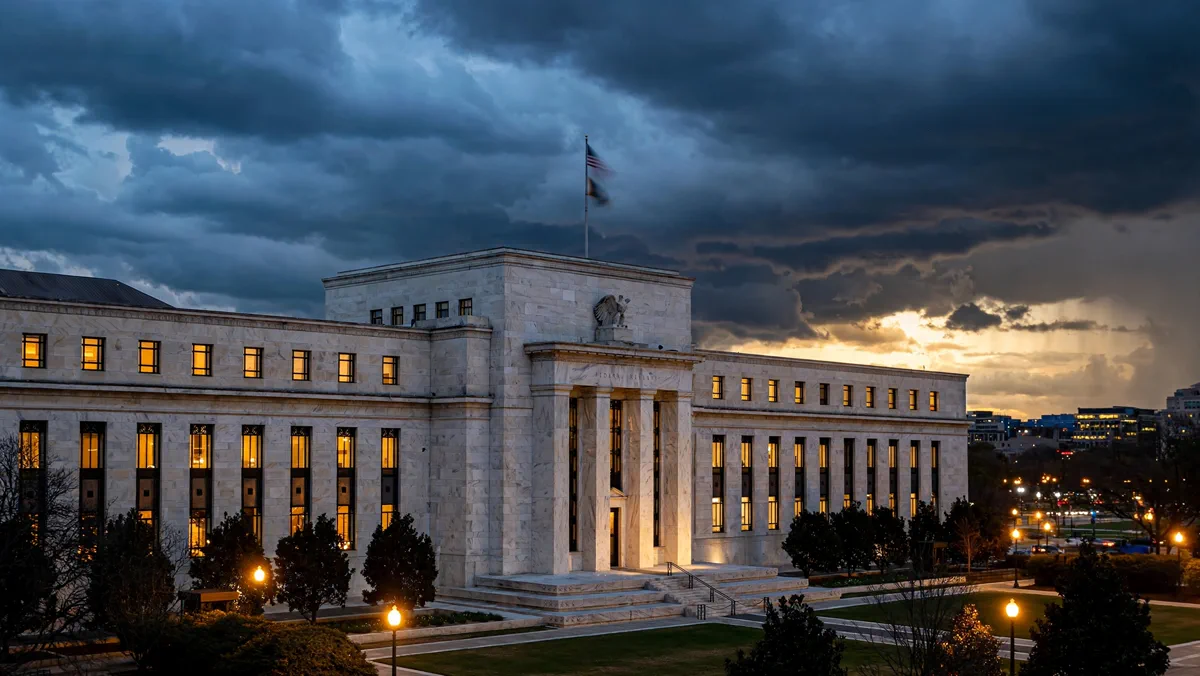
One hundred economists. Zero disagreement.
That is not a headline you see often in economics. These are people who make a living disagreeing with each other, yet in a Reuters poll released today, all 100 of them agreed on one thing: the Federal Reserve is going to raise interest rates again in December.
Not some of them. Not most of them. Every single one.
If you have a mortgage, a credit card balance, a car loan, or any plans to borrow money in the next year, this is the story that decides what all of that costs you. Let me break down what happened, why the Fed is doing it, and what you can actually do about it before December arrives.
The poll that stunned Wall Street
Reuters surveyed 100 economists between October 16 and October 20. The results, published today, were striking on two counts.
First, 94 of the 100 expect the Fed to hold rates steady at the October 27-28 meeting, keeping the federal funds rate in the 3.75% to 4.00% range. Second, and this is the bombshell, all 100 expect a rate hike in December.
To understand why that is such a big deal, look at last month’s poll. Back then, fewer than half of the economists surveyed expected a December hike. Something changed their minds, and it changed every single one of them.
What changed was the data. The September inflation numbers came in hotter than expected: consumer prices up 3.7% from a year ago, with prices rising 0.6% in September alone. Gasoline prices surged 9.1% in a single month and accounted for more than half of that monthly jump. Core inflation, which strips out food and energy, climbed to 2.6% from 2.4%.
The producer price numbers were even uglier. Wholesale prices jumped 6.3% year over year, the biggest increase since December 2022, with wholesale gasoline up 20.3%. When it costs businesses that much more to make things, those costs eventually land in your shopping cart.
Alex Pelle, a senior US economist at Mizuho Securities, put it bluntly in the Reuters coverage: “You have a strong economy and you have inflation. There’s really no reason for you to worry so much about getting interest rates higher, this is like the easiest choice.” He added that the Fed is “really not getting more on top of the issue, they’re just treading water and perhaps even getting a little behind.”
Why the Fed is waiting until December
If inflation is this hot, why not raise rates now, at the October meeting? Two reasons.
The first is that Fed Chair Kevin Warsh is playing it cagey. He has made clear he does not like giving forward guidance, and he has kept mum about the timing of the next move. Fed officials have been sending mixed signals lately, and that confusion has been whipsawing the bond market. Longer-dated Treasury yields shot up to multi-decade highs on October 7, then fell back nearly a quarter of a percentage point as the odds of an October hike faded.
The second reason is sitting on every news homepage this week: the November midterm elections are just days after the October 27-28 Fed meeting. No central bank wants its rate decision to look like an election move, no matter which way it goes. December gives the Fed distance from the ballot box.
So the October meeting is essentially a formality. The real action, and the real cost to your wallet, lands in December.
What a December hike means for your money
Here is where the abstract world of central banking turns into real dollars out of your pocket. A Fed rate hike does not just sit in a press release. It ripples into almost every loan you have.
Mortgages
Mortgage rates have already been brutal. Freddie Mac’s average 30-year fixed rate held at 7.40% on October 15, a three-year high. To see what that feels like in real life, take a $500,000 house with 20% down, meaning a $400,000 loan. At a 6.5% rate, principal and interest run about $2,528 a month. At 7.4%, that same loan costs about $2,770 a month. That is roughly $241 more every month, or $2,895 a year, for the exact same house.
A December Fed hike could push mortgage rates higher still. If you are thinking about buying or refinancing, the window before December matters more than it looks.

Credit cards
This is the painful one. Nearly 13% of credit card balances in the US are now seriously past due, a level close to the peak seen in the aftermath of the 2008 housing crisis. Auto loan delinquencies hit a record high this year. Almost 9% of households are spending more than 40% of their income just servicing debt, the highest share since 2010.
Credit card rates track the Fed’s benchmark almost immediately. If you are carrying a balance, a December hike means higher interest on every dollar of it. Americans are already burning roughly $50 billion a month in interest payments on their debt. A quarter-point hike on record-high balances is not a rounding error. It is real money.
If you carry a balance, the move is simple and boring: attack the principal now, before December. Every dollar of balance you kill today is a dollar that will not be compounding at a higher rate next year.

Savings accounts and CDs
Here is the one place where rising rates actually help you, if you know where to look. The average savings account in America still pays a pitiful 0.38%, according to the FDIC. But the top 1% of high-yield accounts average 4.02%, and the best offers today go up to 5.00% at Axos Bank (with some direct deposit conditions), 4.50% at GO2bank, and 4.34% at Elevault with no minimums.
CD rates are even juicier. The best nationwide deal today is Tower Federal Credit Union’s 5.20% APY on a 24-month CD with just a $500 minimum. Short-term CDs are paying 4.35% to 5.00%.
The catch: banks raise savings yields slowly when the Fed hikes, but they raise loan rates instantly. So the December hike helps borrowers far less than it hurts them. Still, if your money is sitting in an account paying under 1%, moving it before December is the easiest raise you will ever give yourself.
The bigger picture: inflation is not going back to 2% anytime soon
Zoom out for a moment, because this is the part most people miss. The Fed’s preferred inflation measure, the Personal Consumption Expenditures price index, is expected to stay more than a full percentage point above the Fed’s 2% target for several more quarters. Economists in the Reuters survey do not see inflation returning to target until at least 2028.
Several forces are keeping prices high. Energy costs remain elevated with oil above $100 a barrel amid the Iran conflict. Tariffs on imported goods are pushing up costs for businesses and consumers. And the September rate hike, the Fed’s first since 2023, was supposed to start cooling things down, but the inflation data keeps coming in hot.
This is why all 100 economists flipped on December. It is not about politics or panic. It is the data, telling the same story month after month.
What to do before December
You cannot control the Fed. But you can control how much a rate hike costs you. Here is the short list:
- If you carry credit card debt: Pay down as much principal as you can before December. Consider a balance transfer card with a 0% introductory offer if you qualify, which freezes the interest clock while you pay it off.
- If your savings earn under 4%: Move your emergency fund to a high-yield account. The gap between 0.38% and 5.00% on $20,000 is more than $900 a year.
- If you are house hunting: Get pre-approved and lock a rate sooner rather than later. Every quarter point adds real money to a 30-year loan.
- If you have an adjustable-rate loan: Talk to your lender about your options now, before the hike resets your payment upward.
- If you are retired or near it: Short-term CDs and Treasury bills look attractive right now, with yields above 5%. Lock in while the locking is good.
Here is the honest takeaway: 100 economists agreeing on anything is rare enough that you should pay attention. They are not saying this to scare you. They are saying it because the numbers all point the same way.
The Fed will skip October. It will hike in December. And your wallet gets the bill either way, so the smart move is to prepare for it now, not read about it later.
Sources: Reuters (October 20, 2026 economist poll), WSJ Buy Side (October 20 savings and CD rates), Federal Reserve Bank of New York household debt data, Freddie Mac. This article is for informational purposes and is not financial advice.