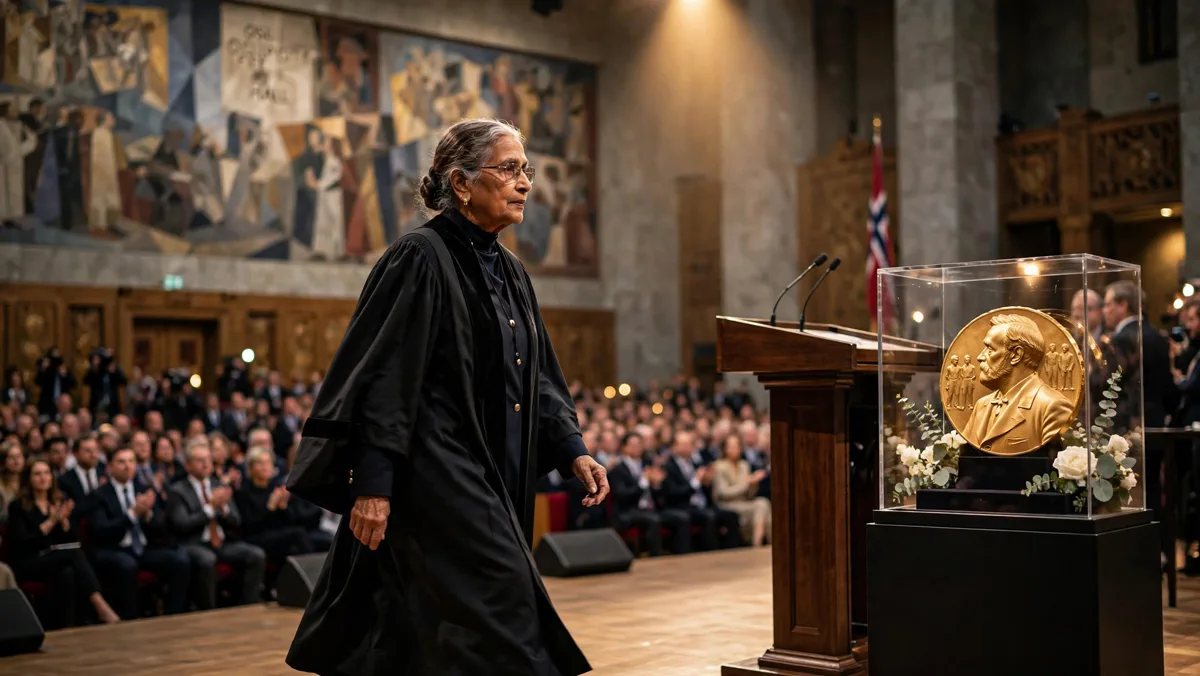
Donald Trump has spent two years saying he deserved the Nobel Peace Prize. On Friday morning, he found out that he was not getting it. Not this year, not this committee, not over the 85-year-old South African judge who walked into Oslo’s spotlight and took the prize he had been circling like a trophy.
The Norwegian Nobel Committee announced that Navanethem “Navi” Pillay, a jurist who has spent six decades building international law case by case, won the 2026 Nobel Peace Prize for her efforts to promote peace and international law. The announcement was one of the most pointed the committee has made in years, and if you read between the lines, it was not really about Pillay’s resume. It was about everyone trying to tear her world down.
And then, within hours of the announcement, the United States sanctioned the International Criminal Court, the very court Pillay once served on. You cannot make this stuff up. Well, apparently you can, because Washington just did.
Who Is Navi Pillay? The Woman Behind the Name
If you had asked most Americans to name the 2026 Nobel favorite yesterday morning, Pillay probably would not have come up. The betting markets certainly did not see her coming. Overnight, Yulia Navalnaya, the widow of Russian opposition leader Alexey Navalny, was the frontrunner, neck and neck with Mykola Kuleba, a Ukrainian children’s rights activist. Then Oslo named a quiet South African jurist, and the entire betting board collapsed.
Her story is worth knowing. Born on September 23, 1941, in Durban, South Africa, to a family of Indian Tamil origin, Pillay grew up under apartheid. Her father drove a bus and worked extra jobs to keep the family afloat. In 1967, she became the first woman of color to practice law in South Africa’s Natal Province, and she spent the next decades defending anti-apartheid activists, including clients connected to Nelson Mandela’s movement.
From there, her career reads like a tour of the world’s courtrooms. She served as a judge on South Africa’s High Court, then on the International Criminal Tribunal for Rwanda, then on the International Criminal Court itself. From 2008 to 2014, she was the United Nations High Commissioner for Human Rights. More recently, she oversaw a 2025 UN investigation that concluded Israel had committed genocide in Gaza, a finding that made her a hero to some and a villain to others.
The committee praised her “firm moral compass” and her unwavering commitment to universal legal principles. But the real headline was the committee’s warning that “the system of international law is under tremendous pressure, and its institutions are under attack,” and that a shift toward power politics was costing the world “stability, trust and peaceful co-existence.” Read that again. That is not ceremony language. That is a distress signal.
Trump Wanted This Prize. Badly.
Let us be honest about how much this one stung in Washington. Trump has said repeatedly that he deserves the Nobel for resolving conflicts, telling reporters on October 7 that he had “settled eight wars, and big ones.” Allies like Florida Representative Anna Paulina Luna said they nominated him for brokering the Israel-Hamas ceasefire and bringing hostages home. And there was an extra layer of awkwardness: last year’s winner, Venezuelan opposition leader Maria Corina Machado, reportedly gave her Nobel medal to Trump earlier this year, an episode that stunned Norway and blurred the lines of the whole prize.
So when Friday came and the prize went to Pillay instead, Trump’s reaction was fast. He did not concede gracefully. He reposted a blistering attack from David Schoen, his former impeachment lawyer, who called Pillay an “unabashed hater of America and Israel” and accused her of celebrating terrorists and running a “phony investigation” of Israel’s conduct in Gaza. Schoen wrote that the committee had “shamed itself beyond repair,” comparing the pick to the committee’s decision to honor Yasser Arafat years ago.
Trump did not add his own words. He did not need to. Reposting the attack on his own platform, hours after the announcement, was the statement.
Hours Later, the US Sanctioned the ICC
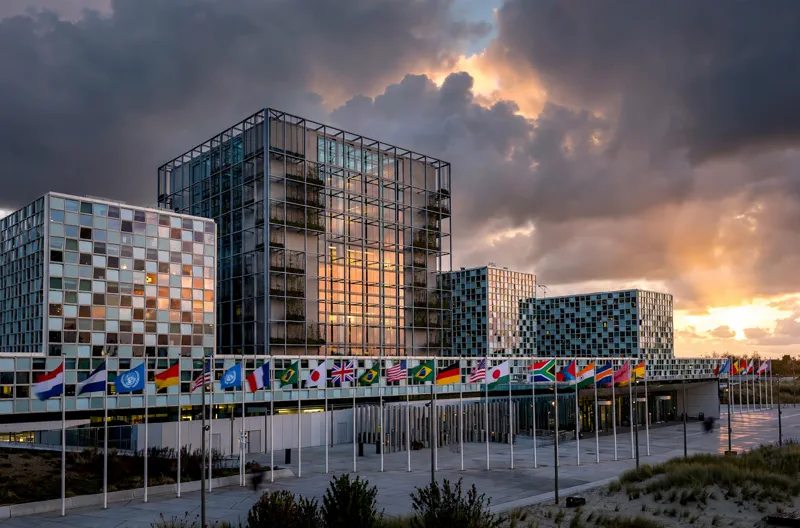
Then came the second punch. On the same day the Nobel committee honored an international jurist, the Trump administration announced severe financial sanctions on the International Criminal Court itself. Secretary of State Marco Rubio said the US would “ban transactions with this rogue court, cutting off their resources and crippling its ability to operate.”
The Treasury Department issued a six-month wind-down waiver for companies doing business with the court, and the State Department framed it as a window for the ICC to demonstrate, in its words, “meaningful progress” on addressing fundamental US concerns. Critics were not buying it. The court condemned the move as an “assault on the rule of law and on the very foundations of the international legal order.”
Eight countries, Canada, Denmark, Germany, France, Italy, Japan, the Netherlands, and the United Kingdom, issued a joint statement reaffirming their “continued and unwavering support” for the court. That list matters. These are not fringe players. They are America’s closest allies, publicly breaking with Washington on the same day Oslo made its choice.
The timing is hard to read as coincidence. The committee spotlights a champion of international justice; the US tries to financially strangle the court she served on. If the Nobel committee wanted a live demonstration of its warning about institutions under attack, Washington volunteered one for free.
The Numbers Behind the Prize
A few facts worth filing away, because this prize has layers:
- The 2026 prize is the 125th Nobel Peace Prize, first awarded in 1901.
- The committee considered 287 nominations this year, just over a quarter of them organizations.
- The prize money is 12 million Swedish kronor, roughly $1.2 million.
- Four other Nobels were announced this week: medicine (a light-based tool to map the brain), physics (neutrino research), chemistry (mirror-image molecules), and literature (Canadian poet Anne Carson). The economics prize comes Monday.
- Pillay will formally receive the prize in Oslo on December 10, 2026.
What Happens Next
The ceremony is two months away, and the fault lines are already visible. Expect the December 10 event in Oslo to be one of the most politically charged Nobel ceremonies in recent memory. Will the US delegation attend warmly, or will Washington make its displeasure felt? Will the sanctions fight with the ICC escalate before then? And will the committee’s warning about the collapse of international law look prescient or alarmist a year from now?
Pillay, for her part, accepted the honor the way she has done everything else: quietly and firmly, standing for the principle that law outlasts power. At 85, she has watched apartheid fall, tribunals rise, and institutions come under fire. She has seen worse than a Truth Social repost.
Trump, meanwhile, still has the medal Machado gave him. It is just not the one he wanted. The committee’s decision was final, the spotlight has moved on to Oslo, and the most powerful man in the world is left doing what he always does when Oslo says no: posting about it.
For more on how US politics keeps colliding with the world stage, see our US News archive, including our look at Trump’s $5,000 check promises and who actually gets paid. For the committee’s full reasoning, the 2026 Nobel Peace Prize page has the official timeline, and CNN’s coverage lays out how the ICC sanctions landed the same day.