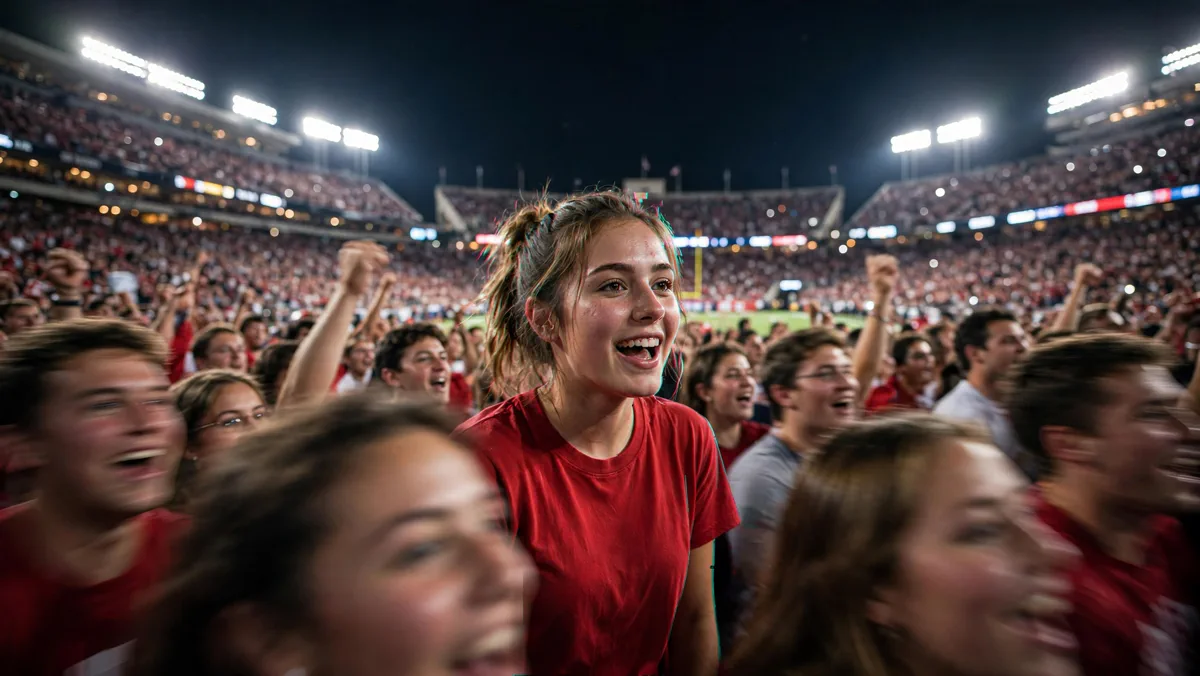
She got 9.6 million views, 38,000 likes, and thousands of comments from men who had absolutely no idea what they were looking at. There was just one problem: she was never in the stadium. She was never in the stands. She was never, in any sense, at the game.
The photo that broke college football Twitter this weekend is fake. Not edited. Not misleading. Fake. AI-generated from nothing, dropped onto a real broadcast screenshot, and sent out into a feed that swallowed it whole. And the wildest part? It worked so well that it is now part of a full-blown trend.
The photo that fooled 10 million people
Here is how the trick worked. Someone took a real screenshot from ESPN’s broadcast of the Texas Tech vs. Houston game earlier this season, a perfectly ordinary crowd shot. Then they pasted an AI-generated woman into the frame, sitting right there in the stands like she belonged.
The side-by-side comparison tells the whole story. The fan on the right is real: an actual frame from the actual broadcast. The fan on the left is the fake: skin too smooth, details that fall apart if you zoom in, a person who simply does not exist. Millions of people shared it before anyone stopped to ask the obvious question.
The Spun, which first flagged the photo this weekend, put it bluntly: the image is most certainly AI-generated, and the whole thing is a reminder to stay skeptical about everything that lands in your feed. Skeptical is putting it gently. Gullible might be closer.
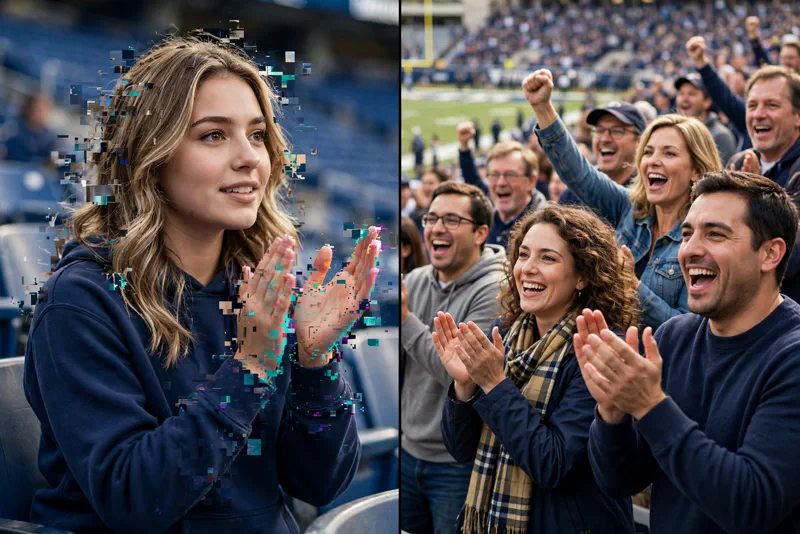
The real one and the fake one
What makes this whole thing extra strange is that the fakes are piggybacking on a real phenomenon. College football broadcasts really do find viral fans in the stands, and it really does happen on live TV.
Earlier this season, Sara Smith, an Ole Miss Rebels fan, went properly viral during an ESPN broadcast. She is a real person with real social media pages and real followers. Nobody had to invent her. The cameras found her, the internet did the rest, and her story checks out from top to bottom.
That is exactly what makes the fake version so sneaky. It copies a formula everyone already recognizes: the broadcast crowd shot, the unexpected star in the stands, the caption about the cameraman doing his job. Your brain has seen this movie before, so it does not ask for ID at the door.
This is not the first fake fan
The Texas Tech photo is just the latest entry in what is quickly becoming a genre. Check the recent highlight reel:
The Miami thirst trap. An Instagram account posted a video of a woman in a Miami Hurricanes jersey standing in a roaring crowd, with a scoreboard showing Miami trailing Texas Tech 28-26 on a two-point try. The caption read, "The cameraman understood the assignment." One problem: Miami had a bye week. There was no game. And Miami has not played Texas Tech since 1990. Texas Tech Athletics confirmed the teams last met on October 27, 1990. The internet’s verdict, delivered by the account College Sports Only: "Miami has not played Texas Tech since 1990," followed by a facepalm emoji.
The Holly Rowe video. A fake, AI-created video showed ESPN sideline reporter Holly Rowe in a white tank top and jeans at a pregame meeting. It pulled close to 2 million views. None of it was real, and Rowe had to deal with the fallout for something she never did.
The NBA Finals clip. A viral fan clip from the NBA Finals back in June drew the same suspicions, and investigators found the same fingerprints.
The World Cup wave. This summer, RTBF’s fact-checkers in Belgium found that many viral World Cup clips of young women in the stands were AI-generated. Those clips drew hundreds of millions of views across platforms. One even showed a frozen match clock and an ESPN logo on a match that ESPN did not broadcast. The trend reportedly started in South Korea earlier this year, and it has been scaling ever since.
See the pattern? A gorgeous stranger, a live broadcast, a camera that just happened to find her. It is catnip for engagement, and engagement is the only currency that matters.
How to spot the fakes before you share them
Nobody expects you to run a forensic analysis on every photo in your feed. But the fakes keep making the same mistakes, and once you know the tells, you start seeing them everywhere:
- Check the game actually happened. The Miami video collapsed the second someone noticed Miami had a bye week. Schedules are public. It takes ten seconds.
- Look for the uncanny details. AI faces still struggle with the small stuff: weird teeth, hands that melt into nothing, skin with no texture, jewelry that does not quite connect to the body.
- Watch the background. Frozen clocks, logos from the wrong network, scoreboards that describe games that never took place. The fake Texas Tech photo rode on a real screenshot, but the added figure never quite sat in the scene correctly.
- Ask why it is so perfect. Real broadcast crowd shots are messy. The lighting is bad, someone is always mid-blink, the framing is accidental. When the "random fan" looks like a magazine shoot, your suspicion should be doing push-ups.
- Reverse image search the frame. If the underlying broadcast screenshot exists somewhere real, the fake addition stands out fast.

Why this matters more than a thirst trap
Okay, let us be honest: on the surface, this is just horny sports Twitter getting fooled by a pretty face that does not exist. Funny, embarrassing, move on. Right?
Not quite. Because the same pipeline that fakes a fan in the stands can fake anything else in the stands, or on the field, or at a protest, or outside a polling place. The technology does not care what it is lying about. The Miami video already showed how easily a fake scoreboard can rewrite what "happened" in a game. Scale that up and the joke stops being funny.
There is also a human cost that gets lost in the laughing emojis. Holly Rowe is a real reporter who had to watch a fake video of herself rack up 2 million views. Sara Smith is a real fan who now shares a genre with people who do not exist. Every convincing fake makes it a little harder for real people to be believed, and a little easier for bad actors to deny real things.
The internet used to have a saying: pics or it didn’t happen. In 2026, the saying needs an update. Pics happened, sure. But did the person in them? Increasingly, the answer is no. The 10-million-view fan was never in those stands. She never bought a ticket, never sat in that seat, never existed at all. And 38,000 people hit like anyway.
Next time a broadcast "finds" the most beautiful fan in the stadium, do yourself a favor: enjoy the moment, then check the schedule. Your skepticism is the only fact-checker that never takes a day off.
Read more viral internet stories in our Viral section, including the Tom Welling hotel photo saga and the hot mic scandal that destroyed the wrong woman’s mentions.
Sources: The Spun, The Spun on the Holly Rowe fake, TotalProSports on the Miami callout.