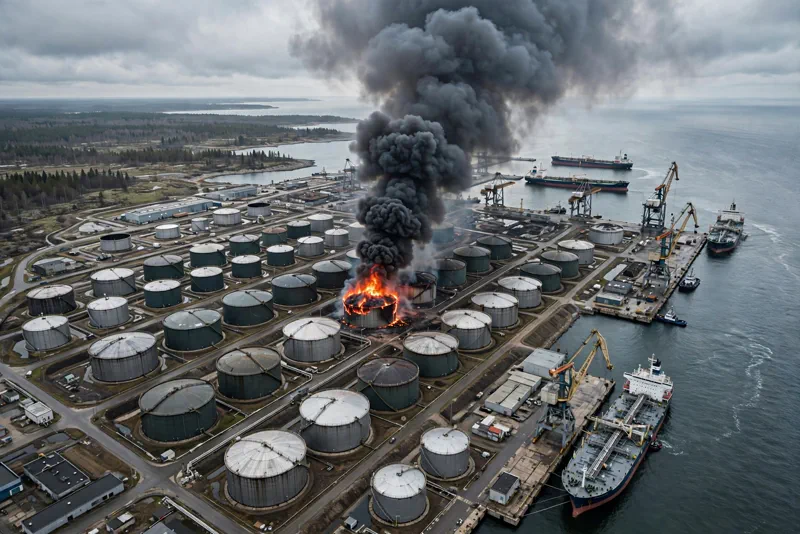
Around midnight in St. Petersburg, the sky started humming. By dawn, one of Russia’s largest oil terminals was burning, a logistics hub was on fire, and the Kremlin was describing what happened as one of the biggest Ukrainian drone attacks of the entire war. This came days after Donald Trump did Moscow two big favors: waiving US sanctions that Congress had mandated, and pressing Kyiv to stop striking Russian refineries. If this was Ukraine’s answer, it was not a subtle one.
One person was killed and 15 were injured in the overnight attack on St. Petersburg and the surrounding Leningrad region, according to local authorities and Reuters. Fires broke out at the St. Petersburg oil terminal, an oil depot and industrial warehouses, the city’s governor Alexander Beglov confirmed. By morning, emergency crews were still working fires across multiple sites, and one of Russia’s busiest airports was restricting flights.
A Night of Drones Over Putin’s Hometown
The scale of the assault is what stands out. Russia’s defense ministry said its air defenses downed 1,015 Ukrainian drones over Russian regions overnight. That number has not been independently verified, but even if it is inflated, the confirmed damage tells its own story. Russian e-commerce company Ozon said its logistics hub in St. Petersburg was on fire. The internet giant VK said its data centre in the Leningrad region had been attacked by drones, adding that services continued to operate normally. The Ukrainian drone manufacturer Fire Point said the Ukrainian military had struck the VK data centre near St. Petersburg.
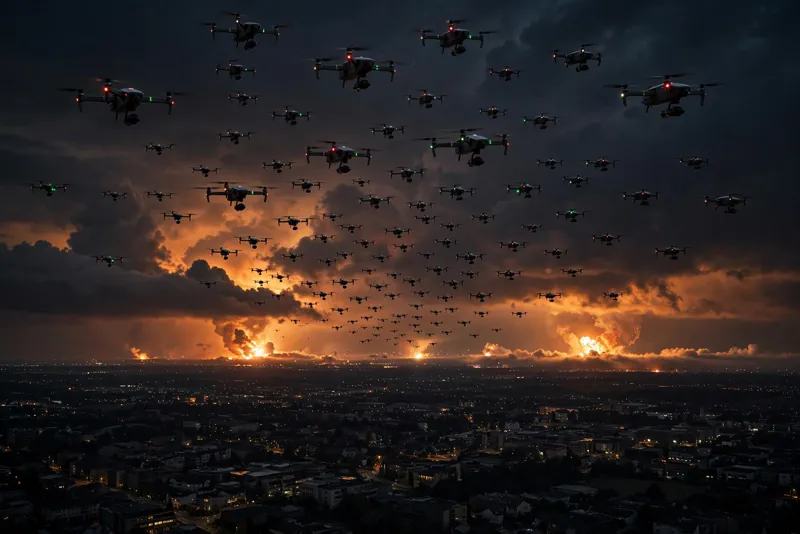
St. Petersburg was not the only target. Moscow’s mayor Sergei Sobyanin reported that air defenses intercepted 87 drones over the capital, and aviation authorities restricted arrivals and departures at two Moscow airports as well as Pulkovo, the international airport serving St. Petersburg. Monitoring channels reported strikes on a power substation and other infrastructure in the Leningrad region, with fires, power outages and water disruptions in several districts.
Why St. Petersburg matters so much
St. Petersburg is Russia’s second city and Vladimir Putin’s hometown, which makes hitting it a psychological blow as well as a material one. It is also a crucial artery of Russia’s oil money. The St. Petersburg oil terminal is a major petroleum handling complex on the Baltic coast, with an annual throughput capacity of roughly 12.5 million tonnes, according to the operator. It is the kind of target Ukraine has been going after for months: not a battlefield position, but the economic machinery that funds the war.
This is not the first time the terminal has been hit. Ukrainian drones attacked it back in June, on the opening day of a major economic forum attended by Russian and foreign officials. That was embarrassing enough. Doing it again, in a single massive wave, sends a different kind of message entirely: Ukraine can reach deep inside Russia whenever it chooses, and no amount of air defense claims changes what the satellite photos will show.
Kyiv Answered the Pressure With Drones
The timing is impossible to ignore. Just days ago, the Trump administration was squeezing Ukraine to stop attacking Russian refineries. US officials pressed Kyiv on the issue in Florida earlier this month. Then on October 16, Trump signed an executive order waiving the Russia sanctions that Congress had passed, days before they were due to take effect. As we reported on this site, he signed the sanctions into law and then shelved them, sparking criticism even from Republicans.
Ukraine’s president Volodymyr Zelensky has been openly furious about all of it. A week ago, Trump announced what he described as an energy ceasefire, meaning Russia would stop hitting Ukraine’s power grid. According to Zelensky, Russia instead attacked Ukraine’s energy and oil and gas sectors 76 times since that announcement. “America should see that Russia is not taking any reciprocal steps in response to sanctions relief or agreements,” Zelensky wrote on X on Sunday. “On the contrary, they take every signal of an opportunity to make money as proof that their bet on war is paying off and they can keep fighting.”
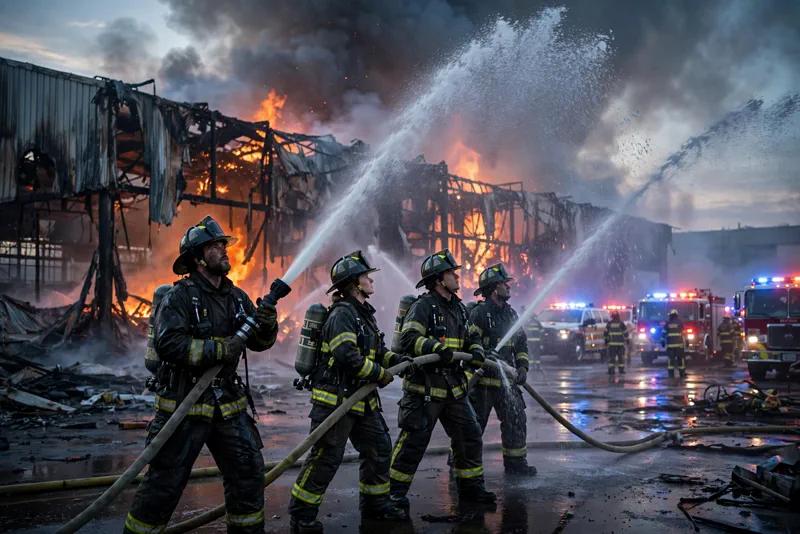
In the 24 hours to Sunday morning, Ukrainian authorities said 11 people were killed and nearly 50 injured across Ukraine in Russian missile and drone attacks, including what they called a massive attack on energy facilities in the Odesa region. That is the other half of this story, the part that rarely makes the headlines in the West: while the world watches the flames in St. Petersburg, Ukrainian civilians are absorbing a nightly rain of missiles and drones. CNN called it one of Ukraine’s biggest drone attacks on Russia this year.
The Starlink complication
Zelensky added another explosive claim on Saturday. He said Ukraine’s access to the Starlink system, used to guide its short-range battlefield drones, remains restricted. “The maximum speed today is 161 kilometers per hour. After that, based on what I have seen and heard in the reports, Starlink shuts down, and we lose the drone,” he said. He added that the restrictions apply on Ukrainian territory but not within the European Union, which he called “a planned operation to restrict us, cut us off and prevent us from defending ourselves and protecting our people.” The Trump administration denies restricting the service. It is a remarkable thing for a wartime president to accuse the United States of, and it tells you everything about how badly the relationship between Kyiv and Washington has frayed.
What Moscow Is Saying
The Kremlin’s response was defiance. Kremlin spokesman Dmitry Peskov said Russia responds to Ukrainian attacks “with systematic, large-scale strikes,” and dismissed the St. Petersburg raid: “The Kyiv regime is resisting. But this cannot change the course of events.” That is the official line. The unofficial reality is that Ukrainian drones have now struck data centres, logistics hubs and oil infrastructure hundreds of miles from the front line, and Russian air defenses, for all the four-digit claims about downed drones, could not stop them.
There is also a domestic angle here that matters. St. Petersburg residents reportedly received delayed or no text-message alerts about the drone threat, according to monitoring reports. Nothing erodes confidence in a government quite like waking up to explosions your phone never warned you about.
What to Watch Next
This story is far from over, and the next 48 hours will decide whether it becomes a turning point or just another night of fire. Here is what I am watching:
- The “energy ceasefire” is effectively dead. Zelensky’s count of 76 Russian energy-sector attacks in a week says it all. The question is whether Trump acknowledges that publicly or keeps pushing Kyiv to show restraint.
- Will Washington punish or reward defiance? Ukraine just humiliated Moscow days after Trump handed Russia sanctions relief. The White House could respond by cutting support, or it could finally admit that the pressure strategy is not working. Neither option is comfortable for Trump with the midterms on November 3.
- The Starlink fight. If Kyiv is right that its drone operations are being throttled, that is a crisis in the making. Expect denials, leaked memos, and a very public argument.
- Russia’s retaliation. Peskov promised “systematic, large-scale strikes.” Ukraine’s power grid, already battered, will likely take the worst of it. The human cost of this escalation will be paid in Kyiv and Odesa, not St. Petersburg.
- The damage assessment. The terminal’s operator has not confirmed how badly the facility was hit or whether loading was suspended. When insurers and shipping data speak, we will know how much this actually cost Russia.
The uncomfortable truth is that both sides are now openly ignoring the American president. Russia kept bombing Ukraine’s energy grid after agreeing to stop. Ukraine kept bombing Russia’s oil after being told to stop. The sanctions Trump shelved were supposed to be leverage. Instead, the war is running on its own logic now, and the logic says: hit the money, hit the grid, and keep going until someone blinks. Nobody is blinking yet.