
Americans Are Burning $50 Billion a Month on Interest Alone
Here is a number nobody is talking about at the dinner table, even though it is quietly eating dinner: $604 billion. That is what American households are now paying in interest every single year. Not rent. Not groceries. Not the mortgage principal itself. Just the interest, the price of borrowing, clocking in at roughly $50 billion every month.
The figure comes from the latest Bureau of Economic Analysis data, reported this week by CNBC, and it should make you sit up. Households are shelling out about $326 billion more in interest than they were back in December 2021. Interest payments now swallow 2.5 percent of disposable personal income, up from 1.5 percent, a level that has historically only shown up late in the economic cycle, when things start getting uncomfortable.
And consumers feel it. The Conference Board’s Consumer Confidence Index just fell 6.7 points in September to 81.9, its lowest reading since 2014. For the first time since the question was introduced four years ago, more Americans described their family’s current financial situation as “bad” than “good.”
So what is going on, why is it hitting now, and what can you actually do about it? Let’s dig in.
The number that should scare you
Fifty billion dollars a month. It is hard to wrap your head around a number that big, so let’s make it personal. That $604 billion annual interest bill works out to roughly $4,500 per American household per year, money that buys you absolutely nothing. No product. No service. No equity. It is the toll you pay for the privilege of owing money in a high-rate world.
The climb has been brutal. Since the zero-rate era ended, the share of income Americans devote to interest payments has jumped by roughly two-thirds. Put another way: one extra cent of every disposable income dollar now goes to interest instead of spending or saving. That might sound small until you multiply it across an entire economy.
What makes this genuinely concerning is the timing. Interest consuming 2.5 percent of disposable income is, historically, a late-cycle signal. It shows up when the economy has already absorbed a lot of tightening and households are starting to crack. It is not a recession verdict by itself, but it is the kind of number economists circle with a red pen.
Why it is happening now
Three forces are colliding at once, and all of them are pushing your borrowing costs higher.
The Fed just started hiking again
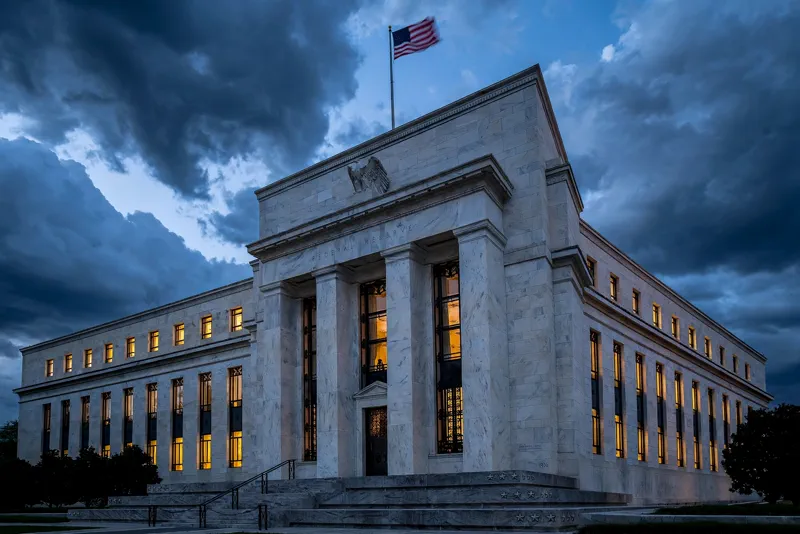
On September 16, the Federal Reserve raised its benchmark rate by a quarter point, its first rate hike since 2023. And officials signaled that at least one more increase could be coming before the end of the year. After years of cuts, the direction of travel has flipped, and every corner of consumer finance feels it within weeks.
When the Fed hikes, credit card rates move almost immediately. Auto loans follow. Mortgages take their cue from the bond market, which has been selling off hard.
The bond market is having a meltdown
The 10-year Treasury yield ended last week around 5.3 percent after touching its highest level since 2002. The 30-year pushed above 5.6 percent, a 24-year high. These yields are the gravitational center of the entire borrowing universe, and right now they are pulling everything upward.
The result: the average 30-year fixed mortgage rate has climbed to about 7.5 percent, its highest level since late 2023. Six weeks ago it was more than half a point lower. On a $400,000 loan, that swing adds hundreds of dollars to the monthly payment. We covered the mortgage freeze in detail last week, and the situation has only gotten worse since.
Prices are still rising faster than paychecks
Inflation expectations are climbing again. Consumers now expect 6.1 percent inflation on average over the next year, and a striking 68.4 percent of them expect interest rates to keep rising. Meanwhile, average hourly wages rose just 3.1 percent over the past year, the weakest gain since May 2021. When your income grows 3 percent and your costs grow faster, the gap gets filled with debt, and debt gets filled with interest.
Confidence just cracked
The September consumer confidence numbers tell a story of a country quietly bracing for impact.
The headline index dropped to 81.9 from 88.6 in August, missing economists’ expectations badly (they were looking for 89). The expectations component, which measures the six-month outlook for business conditions, jobs, and income, slid to 63.6. Readings that low have historically been associated with a recession within the next year.
Here is the detail that sticks with me: for the first time since the Conference Board started asking four years ago, more respondents called their family’s current financial situation “bad” than “good.” That is not a Wall Street metric. That is people answering honestly about their own kitchen tables.
And yet, people keep spending. August outlays rose 0.9 percent even as the saving rate sat at just 4.1 percent. Translation: households are funding their spending by dipping into reserves. That works until it does not. The retirement dream is already on life support, and now the savings cushion underneath it is thinning too.
What this means for your wallet
This is not abstract macroeconomics. It shows up in three places you check every month.

Credit cards
The average credit card APR is hovering above 20 percent, and with the Fed hiking, those rates drift higher still. Carrying a $5,000 balance at 21 percent costs you roughly $87 a month in interest alone, money that does nothing for you. At these rates, minimum payments become a treadmill: you pay and pay, and the balance barely moves.
Mortgages and home equity
At 7.5 percent, the 30-year fixed is pricing millions of would-be buyers out entirely. But it also stings anyone with an adjustable-rate loan resetting, a home equity line tied to the prime rate, or plans to move. The housing market, already frozen, just got another layer of ice.
Savings
There is one genuine bright spot: high-yield savings accounts and CDs are paying 4.5 to 5 percent or more, the best returns savers have seen in years. The catch is that the average savings account still pays a miserable 0.38 percent. If your money is sitting in a big traditional bank, you are subsidizing everyone else’s borrowing.
Five moves to shrink your interest bill
You cannot control the Fed, but you can control how much of your money it lets lenders take. Here is a practical playbook:
- Move your cash to a high-yield account today. If you are earning less than 4 percent on savings, you are leaving real money on the table. Online banks and credit unions are paying 4.5 percent and up. This one move can earn you hundreds of dollars a year on money you already have.
- Attack high-interest debt first. List your debts by interest rate, not by balance. Every dollar shifted from a 21 percent credit card to a 9 percent personal loan (or paid off entirely) is a guaranteed 21 percent return on your money. Nothing in the stock market beats that with zero risk.
- Call your card issuer and ask for a lower rate. It sounds too simple, but it works far more often than people think. A polite five-minute call can shave several percentage points off your APR, and issuers would rather keep you than lose you to a balance transfer.
- Lock in a fixed rate before the next hike. If you have a variable-rate loan, a HELOC balance, or a private student loan with a floating rate, talk to your lender about fixing it. Markets expect another Fed hike this year, and every increase lands directly in your payment.
- Build a one-month buffer, even a small one. With the saving rate at 4.1 percent, most households are one surprise away from the credit card trap. Even $500 to $1,000 in a separate high-yield account breaks the cycle of borrowing for emergencies.
The bottom line
Fifty billion dollars a month is not a statistic. It is millions of households each handing over a little more of their paycheck to lenders, every single month, and getting nothing back. The Fed’s hiking cycle, the bond market selloff, and stubborn inflation have turned borrowing into one of the biggest line items in the American budget.
The good news is that this is one of the rare economic problems where individual action actually moves the needle. Move your savings, kill your highest-rate debt first, and stop paying interest you do not have to pay. In a $604-billion interest economy, the smartest investment you can make is owing less.