Trump Just Invoked Executive Privilege to Hide His Kennedy Center Files. There Is One Problem: He Was Acting as a Board Chair, Not a President.
Late Wednesday night, while most of Washington was asleep, a White House lawyer quietly filed a declaration in federal court that may end up being the most consequential paper ever filed about a performing arts center. President Donald Trump formally invoked executive privilege, the president’s power to shield internal communications from disclosure, to withhold documents about his management of the Kennedy Center.
There is a twist that makes this filing unlike any executive privilege fight in modern history. Trump is not being sued as president. He is being sued as the chairman of a nonprofit board. And the lawyers trying to get those records are arguing that a president cannot wrap himself in presidential privilege while wearing a completely different hat.
What the White House filed on Wednesday night
According to reporting by NBC News, Deputy White House Counsel Joshua Hoyt filed a declaration saying he was acting at “the direction of the President” to formally invoke the presidential communications privilege over materials sought by Rep. Joyce Beatty, D-Ohio. The privilege claim covers, in his words, “information, documents, and communications shared between the President, his advisors (government and non-government), and Kennedy Center staff, pertaining to the management and operation” of the center.
The scope is broad. It covers communications to or from his advisors and Kennedy Center staff, and it specifically touches figures including Commerce Secretary Howard Lutnick and Kennedy Center Executive Director Matt Floca, people who have been in regular contact with Trump about the center’s affairs.
The White House had signaled earlier this month that the privilege claim was coming. Wednesday night’s filing made it official.
The problem: he was sued as a board chairman
Beatty filed her lawsuit back in December, and it challenges two things Trump did at the Kennedy Center. First, his push to add his name to the building, which briefly made it the “Donald J. Trump and The John F. Kennedy Memorial Center for the Performing Arts.” Second, his directive to close the landmark performing arts venue for two years of renovations, a decision he announced on social media in February, months before the board formally voted on it.
Beatty is an ex officio member of the Kennedy Center’s board of trustees, so she has a seat at the table. Her attorneys, Norm Eisen of Democracy Defenders Action and Nathaniel Zelinsky of Washington Litigation Group, did not mince words about the privilege claim.
“Donald Trump appointed himself as chair of the non-profit board of the Kennedy Center, and is now trying to shield his management by improperly invoking executive privilege,” they said in a statement. They added that “this kind of cover-up is a direct assault on the rule of law.”
Their core argument, spelled out in an October 6 filing, is that Trump is being sued in his capacity as board chairman, not as president. The Kennedy Center was created by Congress in 1958, but it is a private nonprofit that sits outside the executive branch and, in their words, “does not exercise executive power.” They noted that the roles of trustee and board chair are not jobs the president must perform and, “indeed, never have been in the Center’s history before now.”
This is the heart of the fight. Executive privilege exists to protect candid presidential decision-making inside the executive branch. Can it cover conversations the president had while running the board of an arts institution he took over as a political project? No court has ever had to answer that question.
What the Justice Department says Beatty already got
The government’s response was blunt. In a separate filing on Wednesday, Justice Department lawyers called Beatty’s requests an improper “fishing expedition” and argued that her “pursuit of irrelevant evidence does not justify her extraordinary request” for more material.
They also stressed that Beatty has already received a mountain of discovery:
- More than 7,500 pages of documents
- Five depositions, including testimony from senior staff
- Responses to 44 requests for admission
The DOJ also countered the legal argument, saying Trump’s involvement with the center “is undoubtedly in his official capacity,” pointing to the president’s responsibility for appointing board members. That is the administration’s position: you cannot separate the president from the chairman, because the chairman only got the job through the president’s appointment power.

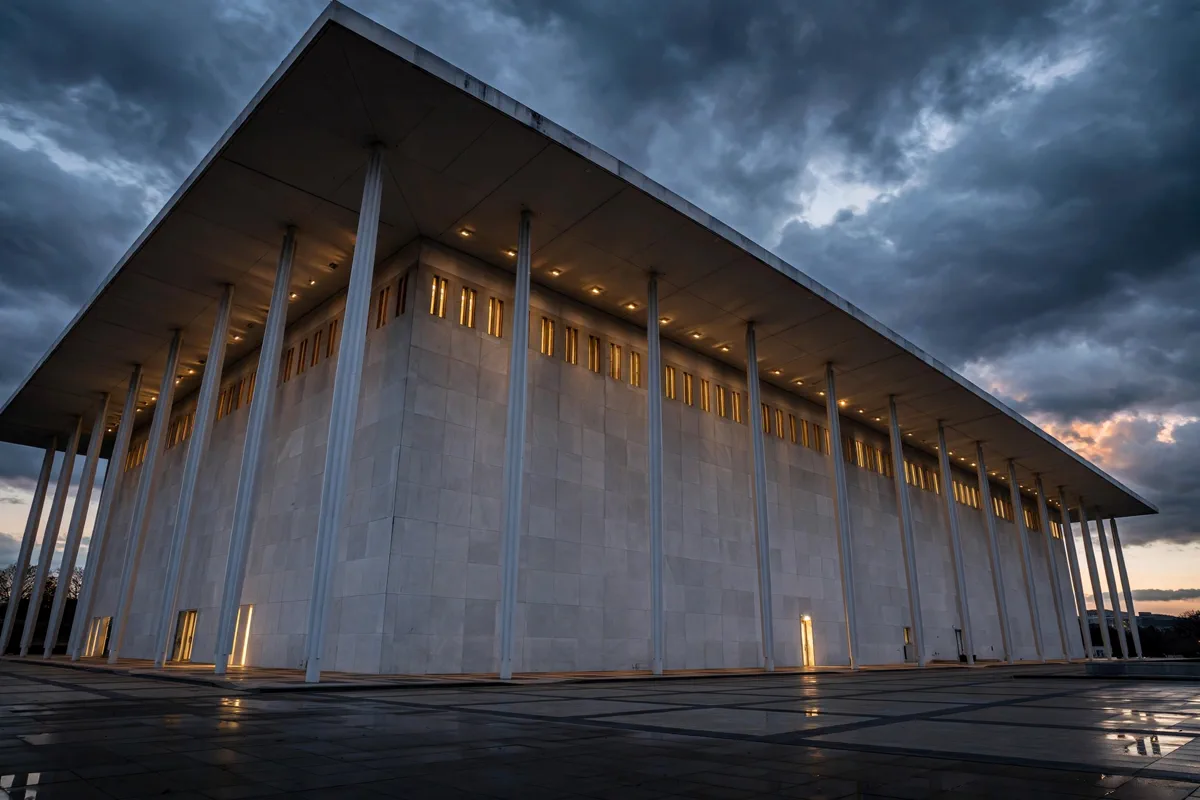
The building at the center of it all is dark and broke
Whatever the courts decide about privilege, the Kennedy Center itself is in rough shape. The building closed on September 15 for what officials described as emergency safety assessments, and it has not reopened since.
The financial picture is grim. Internal documents obtained by CNN showed that after the board voted in December 2025 to put Trump’s name on the building, gifts to the institution plunged 42%, and donation pledges fell by more than 100% from January to April compared with the previous three months. A tax expert told CNN that a decline of that size is possible when earlier pledges are withdrawn outright.
The documents also revealed that ticket sales had fallen to “pandemic levels” in the second quarter, that a slide summarizing the center’s state in May 2025 began with the words “out of cash,” and that the institution ran a deficit of more than $16 million in fiscal year 2025, projected to grow to $23 million this year. Taken together, they paint a picture of an institution bleeding donors and audiences since the takeover.
On top of the money troubles sit allegations of missing donations. Alina Habba, the former interim U.S. attorney for New Jersey turned Trump loyalist, has publicly accused people connected to the center’s former leadership of losing track of donation money, though the exact figures in the claims have shifted and officials have stressed they are only allegations. None of the reporting has established that any money is missing, and a missing record is not the same thing as stolen money.
Then there is the demolition question. Trump said last month that the center would close and “end up being ripped down” unless he and his administration got credit for fundraising and repairs. Judge Cooper has since allowed Beatty’s lawyers to seek information about a photograph showing Trump aboard Air Force One examining a placard that appeared to read “Kennedy Center DEMOLISH.” The center’s lawyers say the building needs massive renovations; Beatty’s side wants to know whether demolition was ever really on the table.

What Judge Cooper does next
U.S. District Judge Christopher Cooper, who is overseeing the case, has not ruled on the privilege claim. He already halted the planned closure back in May and ordered Trump’s name removed from the building’s facade, a ruling that held even as a tarp went up over the front portico.
The immediate timeline is tight. Cooper extended the discovery period through October 23, 2026, ordered the government to produce a renovation PowerPoint presentation in full, and let the board propose only narrowly tailored redactions to a 163-page construction report. Beatty has until October 21 to reply to the privilege arguments, and the question of what must be produced and what can stay hidden must be resolved before discovery closes.
Legal experts expect the privilege question to travel upward regardless of what Cooper decides. It is, as even the filings admit, a novel separation of powers question: can a sitting president claim executive privilege for conversations he had while chairing a private nonprofit board he stocked himself? The answer could outlive this lawsuit by decades.
For now, the Kennedy Center sits dark, its doors shut since mid-September, its finances deteriorating, its fate tied to a courtroom argument about whether the president can keep secrets in a job that has never before belonged to a president. What happens next will be decided in a courtroom, not a concert hall. And the first big answer could arrive within days.
Related reading: Trump Just Bought Millions of Tons of Diesel From Putin, and Zelensky Calls It a Gift | More US News on VIDX
Sources: Newsmax (via NBC News reporting), Particle News, CNN