SpaceX Wants to Borrow $40 Billion for Nvidia Chips, and Wall Street Just Got Its Biggest Test Yet
Elon Musk runs the most famous rocket company on Earth. Now he needs it to become one of the biggest borrowers on Wall Street too.
According to a Financial Times report, first surfaced by Reuters on Tuesday, SpaceX is in talks to raise about $40 billion in debt to buy Nvidia artificial intelligence chips. If it closes, it would be one of the largest debt financings ever tied to the AI buildout. And it tells you everything about where this boom is headed: the chips are getting so expensive that buying them now looks less like a tech purchase and more like building a power plant.
Here is what the deal reportedly looks like, why Musk wants the chips so badly, and why even lenders who love AI are starting to look nervous.

The $40 billion deal on the table
The reported package splits into two pieces. Roughly $10 billion in bank loans and about $30 billion in investment-grade debt. Apollo Global Management is expected to lead the financing and place the debt with a broad range of investors, with bond giant Pimco reportedly among a small group of lenders in early talks. If it moves forward, the transaction is expected to close in 2027.
A couple of important caveats. The Financial Times cited people familiar with the matter, and SpaceX, Apollo, and Nvidia have not publicly confirmed anything. Reuters reported that Pimco declined to comment. These deals can fall apart in the early stages, so treat the structure as the current state of negotiations rather than a done deal.
But the market took it seriously. SpaceX shares (ticker SPCX) slipped in extended trading after the report and fell about 2.5% on Wednesday, snapping a three-day rally. Nvidia ticked up about 0.5% after the Tuesday report before slipping 0.7% on Wednesday. Nothing dramatic, but noticeable: investors are asking whether even a company like SpaceX can digest this much debt.
Why a rocket company needs this many chips
SpaceX stopped being just a rocket company the moment Musk folded xAI into it earlier this year. The company behind the Grok chatbot and the Colossus supercomputing clusters now lives under the same corporate roof as Starship and Starlink. That merger put SpaceX at the center of two of the most capital-hungry businesses on the planet: space infrastructure and frontier AI.
Musk has said SpaceX will use Nvidia hardware exclusively in its data centers. Last month he said the Colossus 2 data center could more than double its Nvidia chip count by December. The company is racing toward 2 gigawatts of AI compute by the end of the year, up from 1.4 gigawatts at the end of the second quarter, and it has talked about deploying data centers in orbit in the coming years. It even rents out Colossus computing capacity to other AI developers, mainly Anthropic and Alphabet’s Google, which makes SpaceX part landlord, part tenant in the AI infrastructure business.
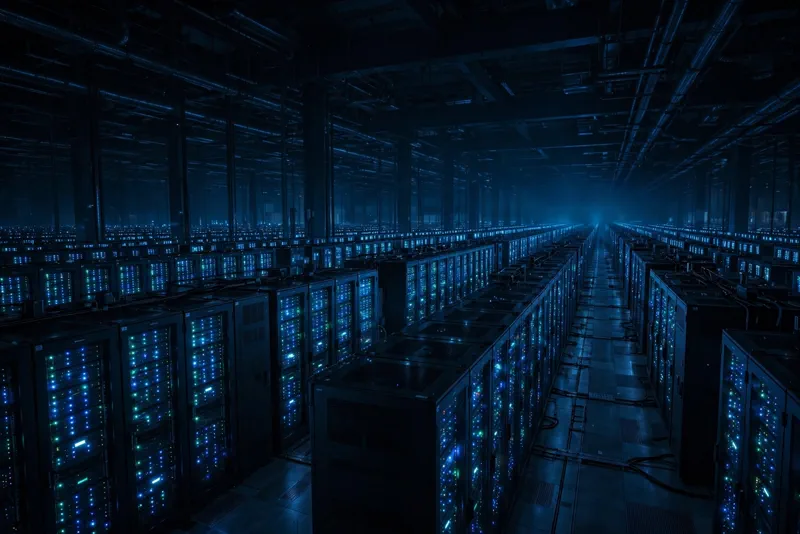
The sheer scale explains the price tag. Trackers following the buildout have pointed to SpaceXAI targets in the millions of GPUs across Colossus facilities, with plans for hundreds of thousands of additional GB300 GPUs at Colossus 2. At this size, you do not buy chips out of petty cash. You finance them.
Chips are starting to be financed like airplanes
This is the part that actually matters beyond Musk’s empire. The AI industry is hitting a wall where the hardware has to be bought, powered, cooled, and installed long before the revenue from that compute fully arrives. That cash-flow gap is pulling banks, asset managers, private-credit firms, and bond investors deep into an industry that used to be financed mostly off big tech balance sheets and venture capital.
Morgan Stanley estimates AI infrastructure will need $1.5 trillion in external financing by 2028, even as lenders and investors grow more cautious about funding the expansion. In August, Nvidia itself partnered with Apollo, BlackRock, Blackstone, Brookfield, Goldman Sachs, and KKR on financing platforms aimed at mobilizing more than $500 billion for AI infrastructure projects. Anthropic-related chip financings have already pushed similar structures into record territory.
If this keeps going, Nvidia accelerators and the data centers around them start to look like aircraft or power plants: long-lived assets backed by contractual cash flows rather than ordinary technology spending. That is a profound shift, and it is also why investors are nervous. Aircraft have predictable revenue. AI compute does not, at least not yet.
What this tells us about the AI boom right now
- Demand is not the question. Capital is. Musk would not borrow $40 billion for chips he was not sure he could use.
- The financing arms race is real. Every major AI player is now competing not just for chips but for the credit to buy them.
- Lenders are getting cautious. Morgan Stanley’s warning about caution sits right alongside its $1.5 trillion estimate.
- Debt markets are the new battlefield. Who can borrow cheapest may matter as much as who builds the best model.
- Nvidia wins either way. Every one of these financing deals ends with more Nvidia chips being sold.
Musk’s week in context
The $40 billion plan did not land in a vacuum. It has been a loud week for Musk’s orbit. On Wednesday morning, he announced an update to the Grok Bot AI assistant: going forward, it will use whatever backend model gives the best outcome for a given task, including rival APIs like Claude Opus 5.5, Midjourney, and Suno. That is a striking admission from a man building his own models, and a pragmatic one. Users care about answers, not brand loyalty.
Meanwhile, the FCC granted SpaceX approval to expand its Starlink constellation with thousands of additional second-generation satellites for its Starlink Mobile service. And in a quieter subplot, Musk downplayed Taiwan Semiconductor Manufacturing’s role in his Terafab chip venture, a comment that sent TSMC shares down 2.1% while Intel rose 0.6%, according to Wednesday’s market roundup. Musk’s chip ambitions, it turns out, run from buying Nvidia’s by the billions to building his own.
All of this comes barely four months after SpaceX went public in June in a record IPO of around $86 billion, giving Musk one of the most valuable private-to-public stories of the year. The stock has had a strong run, which makes Wednesday’s dip look less like panic and more like the market doing quick math: $40 billion in new debt is a lot of math, even for SpaceX.

The bottom line
Strip away the zeros and the story is simple. The AI boom has entered the phase where the winners are decided by who can finance the machines, not just who designs them. SpaceX is betting $40 billion that compute demand will keep outrunning every constraint. Wall Street is deciding whether to believe it.
Read more on the Technology desk, including our look at Google’s $1 billion nuclear deal to keep its own AI fed. The chips need power, the power needs financing, and everybody is suddenly in everybody else’s business.